

Many new business owners assume leasing vehicles is impossible without established credit or lengthy trading history. This misconception stops entrepreneurs from accessing flexible transport solutions that could support their growth. In reality, the UK leasing market in 2026 offers numerous options specifically designed for startups, self-employed professionals, and small businesses with limited or poor credit. This guide explains how vehicle leasing works for new businesses, compares available options, and shows how flexible leasing supports cash flow management whilst building operational capability.
Table of Contents
- Understanding Vehicle Leasing Basics For New Businesses
- Why Leasing Suits New And Small Businesses With Limited Credit
- Comparing Leasing Options: Contract Hire, Short-Term Leasing And No Deposit Deals
- How Leasing Helps New Businesses Manage Cash Flow And Operational Flexibility
- Explore Flexible Vehicle Leasing Options For Your New Business
- Explain Leasing For New Businesses: Frequently Asked Questions
Key takeaways
| Point | Details |
|---|---|
| Flexible access | Leasing provides vehicle access without large upfront costs, preserving capital for core business needs |
| Credit-friendly options | Tailored plans exist for new businesses and limited credit profiles, including no deposit and short-term arrangements |
| Predictable budgeting | Fixed monthly payments help manage cash flow and avoid unexpected vehicle ownership costs |
| Operational agility | Short-term contracts allow businesses to adjust vehicle needs as operations evolve |
Understanding vehicle leasing basics for new businesses
Vehicle leasing allows businesses to use cars or vans for a fixed period through regular payments, without purchasing the asset outright. Unlike buying, where you own the vehicle and bear depreciation risk, lease agreements allow use of a vehicle for a fixed term with regular payments, often without full ownership. This arrangement suits businesses needing reliable transport without tying up capital in depreciating assets.
UK business leasing contracts typically specify the lease duration, monthly payment amount, annual mileage allowance, and maintenance responsibilities. Contract hire, the most common type, involves fixed monthly payments covering vehicle use, road tax, and often maintenance. At contract end, you simply return the vehicle. Understanding van leasing terminology helps you navigate agreements confidently.
Key terms you'll encounter include:
- Contract length: typically 6 to 24 months for flexible arrangements, longer for traditional leases
- Mileage allowance: agreed annual distance, with excess charges for overuse
- Maintenance packages: optional coverage for servicing, tyres, and repairs
- Initial payment: upfront cost, sometimes waived in no deposit deals
For startups and small businesses, leasing offers significant cash flow advantages. Rather than spending £20,000 to £40,000 purchasing a vehicle, you preserve capital for inventory, marketing, or hiring. Monthly lease payments become predictable operational expenses, simplifying budgeting and financial planning. This approach proves particularly valuable during the vulnerable early trading period when cash reserves determine survival.
Pro Tip: Calculate your actual monthly vehicle usage and mileage needs before signing any lease. Choosing the right mileage allowance prevents costly excess charges whilst avoiding overpayment for unused miles.
Why leasing suits new and small businesses with limited credit
Traditional vehicle finance often requires strong credit scores and established trading history, creating barriers for new businesses. However, the UK leasing market has evolved to serve entrepreneurs and startups facing these challenges. Leasing can be popular among businesses with limited credit, offering flexible terms that adapt to credit profiles, making transport accessible when conventional loans prove difficult.
Flexible leasing providers recognise that new businesses may lack lengthy credit files or perfect scores, yet still represent reliable customers. They assess applications holistically, considering business plans, projected income, and personal circumstances rather than relying solely on credit scores. Some providers conduct soft credit checks that don't impact your credit file, removing the risk of multiple applications damaging your score.
Short-term leasing options provide alternatives for those with poorer credit histories, offering 6 to 12 month contracts that reduce provider risk whilst giving businesses affordable access. These arrangements prove ideal for testing business models, covering seasonal demand, or bridging gaps until traditional finance becomes available.
Key advantages of leasing for limited credit businesses include:
- No large upfront deposits required with certain plans
- Approval based on current circumstances rather than past credit issues
- Opportunity to build positive payment history for future applications
- Access to newer, more reliable vehicles than outright purchase budgets might allow
The cash flow benefits prove particularly crucial for new businesses. Avoiding £5,000 to £10,000 initial deposits means capital remains available for stock, equipment, or unexpected expenses. Predictable monthly costs simplify financial planning during uncertain early trading periods. If business circumstances change, short-term leasing benefits include easier exit strategies compared to long-term finance commitments.
"Leasing transformed our startup logistics. Without established credit, we couldn't secure traditional vehicle finance. Flexible leasing gave us reliable vans within days, preserving cash for inventory whilst building our delivery capability."
Pro Tip: When applying for leasing with limited credit, prepare documentation showing stable income, business plans, and any existing positive payment records. Transparency about your circumstances helps providers assess your application fairly.
Comparing leasing options: contract hire, short-term leasing and no deposit deals
Understanding different leasing types helps new businesses select arrangements matching their operational needs and financial circumstances. Three main options dominate the UK market in 2026, each offering distinct advantages for startups and small enterprises.
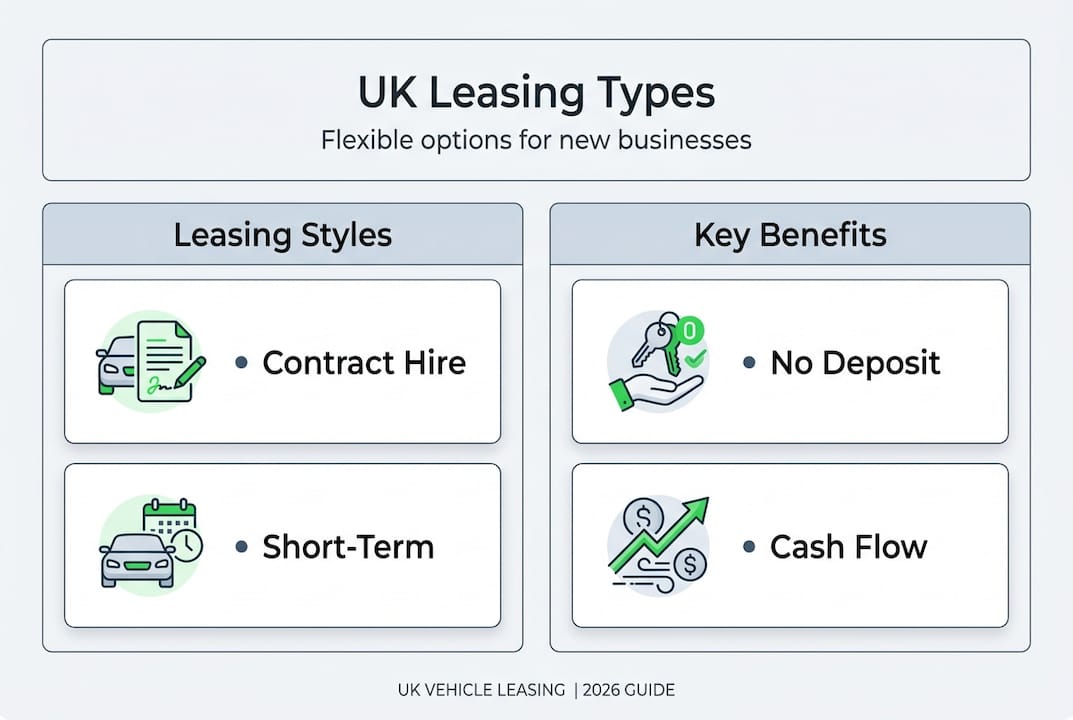
Contract hire represents traditional business leasing, typically spanning 24 to 48 months with fixed monthly payments covering vehicle use, road tax, and optional maintenance. You return the vehicle at contract end without ownership responsibilities. This option suits businesses with predictable long-term vehicle needs and stable cash flow. However, lengthy commitments may not suit rapidly evolving startups.
Short-term leasing provides flexible contract length options that help businesses tailor leasing terms to their needs, typically 6 to 24 months. These arrangements offer greater flexibility for testing business models, covering seasonal peaks, or bridging temporary transport needs. Monthly costs run slightly higher than long-term contracts, but the reduced commitment suits uncertain business environments.
No deposit leasing can reduce initial financial barriers for new businesses, eliminating upfront payments of £1,000 to £3,000 typical in standard arrangements. Instead, you begin with just the first monthly payment, preserving capital for operational needs. This option proves particularly valuable for startups with limited reserves or those prioritising cash flow over minimising total lease costs.
| Leasing Type | Typical Duration | Initial Payment | Monthly Cost | Best For | | --- | --- | --- | --- | | Contract Hire | 24-48 months | 1-3 months' payment | Lower | Established needs, stable operations | | Short-term Lease | 6-24 months | 1-2 months' payment | Moderate | Testing models, seasonal demand | | No Deposit Lease | 6-36 months | None | Higher | Cash flow priority, limited reserves |
When comparing options, consider:
- How certain are your vehicle requirements over the next 12 to 24 months?
- Can you afford initial deposits, or must you preserve all available capital?
- Do you need flexibility to change vehicles as your business evolves?
- What total cost matters more: lowest monthly payment or minimal upfront expense?
For most new businesses, flexible contract leasing between 12 to 18 months balances commitment and flexibility well. This duration provides stability for planning whilst allowing reassessment as your business matures. Combining flexible terms with no deposit leasing explained options maximises cash preservation during critical early trading periods.
Pro Tip: Calculate total lease costs across the full contract period, not just monthly payments. Sometimes slightly higher monthly costs with no deposit prove more economical than lower payments requiring large upfront sums, especially when considering opportunity costs of tied-up capital.
How leasing helps new businesses manage cash flow and operational flexibility
Cash flow challenges cause more business failures than lack of profitability. New enterprises particularly struggle balancing investment in growth against maintaining sufficient working capital. Vehicle leasing directly addresses these pressures through predictable costs and capital preservation.
Leasing allows businesses to preserve capital and maintain predictable monthly costs, aiding cash flow management. Instead of spending £15,000 to £30,000 purchasing a vehicle outright, that capital remains available for inventory, marketing, hiring, or emergency reserves. For a startup with £50,000 working capital, avoiding a £20,000 vehicle purchase means 40% more financial flexibility.

Predictable monthly expenses simplify financial planning and budgeting. Fixed lease payments of £250 to £450 monthly become regular operational costs, easily incorporated into cash flow projections. Unlike vehicle ownership, where unexpected repairs or maintenance create budget shocks, comprehensive lease packages include servicing and often tyres, eliminating surprise costs.
Leasing supports operational agility as your business evolves:
- Start with a single vehicle for initial operations and customer testing
- Add vehicles as demand grows without large capital outlays for each addition
- Upgrade to larger or more suitable vehicles when requirements change
- Reduce fleet size during quieter periods by not renewing contracts
- Access newer, more fuel-efficient vehicles regularly, controlling running costs
This flexibility proves invaluable for businesses navigating uncertain markets or testing different operational models. A catering startup might begin with a small van, upgrade to a larger vehicle as the customer base grows, then add refrigerated vehicles when expanding into new product lines. Each transition happens through manageable monthly payments rather than requiring major capital investments.
Vehicle depreciation represents another hidden cost of ownership. New vehicles lose 15% to 35% of value in the first year, with continued depreciation over subsequent years. Leasing transfers this risk to the provider. You pay only for vehicle use during your contract period, then return it without worrying about resale values or disposal logistics.
"Our seasonal business needs vehicles intensively for six months, then barely at all. Short-term leasing lets us scale transport capacity up and down annually without the burden of owned vehicles sitting idle half the year. This flexibility transformed our cost structure."
For businesses building credit profiles, consistent lease payments create positive payment history. Reliable monthly payments demonstrate financial responsibility to future lenders, gradually improving credit scores and opening access to broader financing options as your business matures.
Pro Tip: Track how leasing for cash flow management impacts your overall financial health. Compare your actual operational flexibility and capital availability against what you'd face having purchased vehicles outright. This analysis helps optimise future leasing decisions.
Explore flexible vehicle leasing options for your new business
Navigating vehicle leasing as a new business owner requires expert guidance and access to flexible, credit-friendly options. Flexi Auto Lease specialises in supporting UK startups, self-employed professionals, and small businesses with tailored leasing solutions designed around your circumstances, not just credit scores.

Our flexible vehicle leasing solutions include short-term contracts from 6 to 24 months, no deposit options, and soft credit checks that protect your credit file. We understand new businesses face unique challenges and structure agreements supporting your growth journey. With nationwide delivery, all-inclusive pricing covering road tax and maintenance, and approval processes enabling you to drive within days, we remove barriers between your business needs and reliable transport. Explore how flexible leasing can support your operational goals whilst preserving precious working capital for building your business.
Explain leasing for new businesses: frequently asked questions
Can I lease a vehicle for my business with no credit history?
Yes, many UK leasing providers in 2026 offer options for businesses without established credit history. They assess applications based on your current business plan, projected income, and personal circumstances rather than relying solely on credit scores. Some providers conduct soft credit checks or no credit checks, making approval accessible for new businesses. Flexible short-term leases and no deposit options further reduce barriers for startups.
What is the main difference between leasing and buying a vehicle for business?
Leasing involves paying for vehicle use over a fixed period through monthly payments, then returning the vehicle at contract end without ownership. Buying requires full purchase price upfront or through finance, resulting in asset ownership but bearing depreciation risk and disposal responsibilities. Leasing preserves capital, offers predictable costs, and provides flexibility to change vehicles, whilst buying builds equity but requires larger initial investment.
How does no deposit leasing benefit new businesses?
No deposit leasing eliminates upfront payments of £1,000 to £3,000, allowing businesses to access vehicles with just the first monthly payment. This preserves working capital for inventory, marketing, equipment, or emergency reserves during critical early trading periods. For startups with limited cash reserves, avoiding large initial deposits can mean the difference between accessing necessary transport or delaying operations whilst saving funds.
Can I customise my lease contract length?
Yes, flexible leasing providers offer contracts from 6 to 24 months, allowing you to match commitment periods to your business needs and certainty levels. Shorter contracts suit businesses testing models or covering seasonal demand, whilst longer terms typically offer lower monthly costs for stable operations. You can often extend or renew contracts as circumstances evolve, providing ongoing flexibility.
How does leasing support business budgeting and cash flow?
Leasing creates predictable fixed monthly expenses easily incorporated into financial planning, unlike vehicle ownership where repairs and maintenance create budget surprises. By avoiding large upfront vehicle purchases, businesses preserve capital for operational needs and growth investments. Comprehensive lease packages including road tax, servicing, and maintenance eliminate unexpected costs, whilst the ability to return vehicles at contract end removes depreciation risk and disposal concerns.