

Many people believe poor credit automatically disqualifies them from accessing reliable vehicles, yet this misconception overlooks one of the fastest growing solutions in the UK market. Vehicle leasing has emerged as a practical alternative for individuals and small business owners facing credit challenges, offering flexible terms and lower upfront costs than traditional financing. This guide explores why leasing continues to gain popularity among those with limited or poor credit histories, examining the financial accessibility, adaptability, and credit rebuilding opportunities that make it an increasingly trusted choice across the UK in 2026.
Table of Contents
- How Leasing Makes Vehicle Access Easier With Limited Or Poor Credit
- The Flexibility Of Leasing: Adapting To Your Changing Needs
- How Leasing Helps Manage Cash Flow And Rebuild Credit
- Market Growth And Trends In UK Asset Finance Supporting Vehicle Leasing
- Explore Flexible Vehicle Leasing Options With FlexiAutoLease
- Frequently Asked Questions
Key takeaways
| Point | Details |
|---|---|
| Lower upfront costs | Leasing requires smaller deposits than purchasing, reducing initial financial strain for those with limited credit |
| Flexible upgrade options | Short-term contracts allow vehicle changes every few years, adapting to evolving personal or business needs |
| Credit rebuilding potential | Consistent on-time lease payments build positive credit history, improving future finance opportunities |
| Cash flow advantages | Lower monthly outgoings help manage budgets effectively, particularly beneficial for small businesses |
| Market growth evidence | UK asset finance supporting SMEs exceeded £24 billion in 2025, demonstrating rising trust in leasing solutions |
How leasing makes vehicle access easier with limited or poor credit
The financial barriers to vehicle ownership often seem insurmountable when you're working with limited or poor credit. Traditional car loans typically demand substantial down payments, sometimes reaching 20% of the vehicle's value, alongside interest rates that climb steeply for borrowers with challenged credit profiles. Leasing fundamentally changes this equation by requiring significantly lower initial deposits, making vehicle access achievable for individuals and small businesses previously locked out of conventional financing routes.
Monthly payments for leasing are often lower than those for a car loan, reducing the upfront financial burden that appeals to those with limited credit. This cost advantage stems from leasing's structure, where you're essentially paying for the vehicle's depreciation during your contract period rather than its entire purchase price. The monthly savings can be substantial, freeing up capital for other essential expenses or business investments.
Beyond lower costs, many leasing providers now employ flexible approval criteria that look beyond traditional credit scores. Some specialists use trust scores or alternative assessment methods that consider factors like current income stability, employment history, and bank account behaviour. Whilst you might face slightly higher interest rates or larger deposits compared to borrowers with excellent credit, the accessibility remains dramatically better than attempting to secure a standard car loan. This approach recognises that past financial difficulties don't necessarily predict future payment reliability, particularly when circumstances have improved.
For small business owners, this accessibility proves especially valuable. You can secure commercial vehicles or company cars without depleting working capital reserves, maintaining the financial flexibility needed to respond to opportunities or unexpected challenges. The barrier to entry drops considerably, allowing businesses at various growth stages to access the vehicles they need for operations.
Key accessibility factors that benefit limited credit applicants:
- Lower deposit requirements compared to purchase finance
- Reduced monthly payment amounts improving affordability
- Alternative assessment methods beyond traditional credit scores
- Faster approval processes with specialised providers
- Flexible terms accommodating varied financial situations
"Leasing opens doors that traditional financing keeps firmly closed. For someone rebuilding their credit profile, the difference between a £2,000 deposit and a £6,000 down payment can mean the difference between mobility and being stranded."
This fundamental shift in accessibility explains why car leasing for bad credit has become increasingly popular across the UK, particularly among those who've experienced financial setbacks but maintained stable employment and income.
The flexibility of leasing: adapting to your changing needs
Flexibility stands as one of leasing's most compelling advantages, particularly for individuals actively working to improve their credit standing. Lease terms typically range from 2 to 4 years, enabling regular vehicle upgrades and adjustment to credit improvements. This timeframe aligns perfectly with credit rebuilding journeys, allowing you to start with accessible terms today whilst positioning yourself for better rates when your contract ends and your credit score has recovered.
The ability to change vehicles every few years delivers practical benefits beyond credit considerations. Your personal circumstances might shift dramatically during a typical lease period. Perhaps your family grows, requiring a larger vehicle, or your business expands, necessitating additional commercial capacity. Traditional ownership locks you into lengthy commitments, forcing you to navigate the costly and time-consuming process of selling before you can adapt. Leasing sidesteps this entirely, building adaptability directly into the agreement structure.

For businesses, this flexibility becomes even more strategic. Business contract hire simplifies fleet management and preserves working capital for UK businesses, eliminating the administrative burden of vehicle maintenance, depreciation management, and eventual resale. You can scale your fleet up or down as contracts expire, matching vehicle capacity precisely to current operational needs without the capital intensity of ownership. This agility proves invaluable in uncertain economic conditions where business volumes fluctuate.
Numbered steps to maximise leasing flexibility:
- Assess your anticipated credit improvement timeline before selecting contract length
- Choose initial terms that align with when you expect better credit-based rates
- Document all on-time payments to strengthen your position for contract renewal
- Review your vehicle needs annually to plan appropriate upgrades at contract end
- Maintain open communication with your leasing provider about changing circumstances
The avoidance of depreciation risk deserves particular attention. Vehicles lose value rapidly, with new cars typically dropping 15-20% in their first year alone. When you lease, this depreciation becomes the provider's concern, not yours. You simply return the vehicle at contract end and move on, never worrying about resale values, market timing, or finding buyers. This predictability helps with long-term financial planning, especially valuable when you're working to stabilise your overall financial situation.
Pro Tip: If you're actively rebuilding credit, consider starting with a shorter 24-month lease term. This allows you to demonstrate consistent payment history, then refinance into a better rate sooner than a longer contract would permit, whilst still enjoying the flexibility to upgrade vehicles as your situation improves.
Exploring leasing tips for small businesses and understanding flexible contract length options can help you structure agreements that support both immediate needs and future growth.
How leasing helps manage cash flow and rebuild credit
Cash flow management often determines success or failure for small businesses and individuals working with tight budgets. Leasing offers lower monthly outgoings compared to financing, supporting cash flow by reducing the regular financial commitment required to maintain vehicle access. This difference might seem modest on paper, perhaps £50-150 monthly depending on the vehicle, but that margin accumulates to substantial annual savings that can be redirected toward business growth, emergency funds, or other financial priorities.
For VAT-registered businesses, the financial advantages extend further. You can reclaim a portion of the VAT paid on lease rentals, effectively reducing your net cost. Passenger cars typically allow 50% VAT reclaim, whilst commercial vehicles may qualify for 100% reclamation depending on usage. This tax efficiency makes leasing particularly attractive compared to outright purchase, where VAT reclaim opportunities are more limited. The cumulative effect on your bottom line can be significant, improving profitability without requiring operational changes.
The credit rebuilding aspect deserves careful attention. Consistent on-time lease payments can positively impact credit scores, improving future finance options by demonstrating reliable payment behaviour over an extended period. Most reputable leasing companies report payment history to credit reference agencies, meaning every punctual payment strengthens your credit profile. This creates a virtuous cycle where accessible leasing today builds the credit foundation for better financing terms tomorrow.
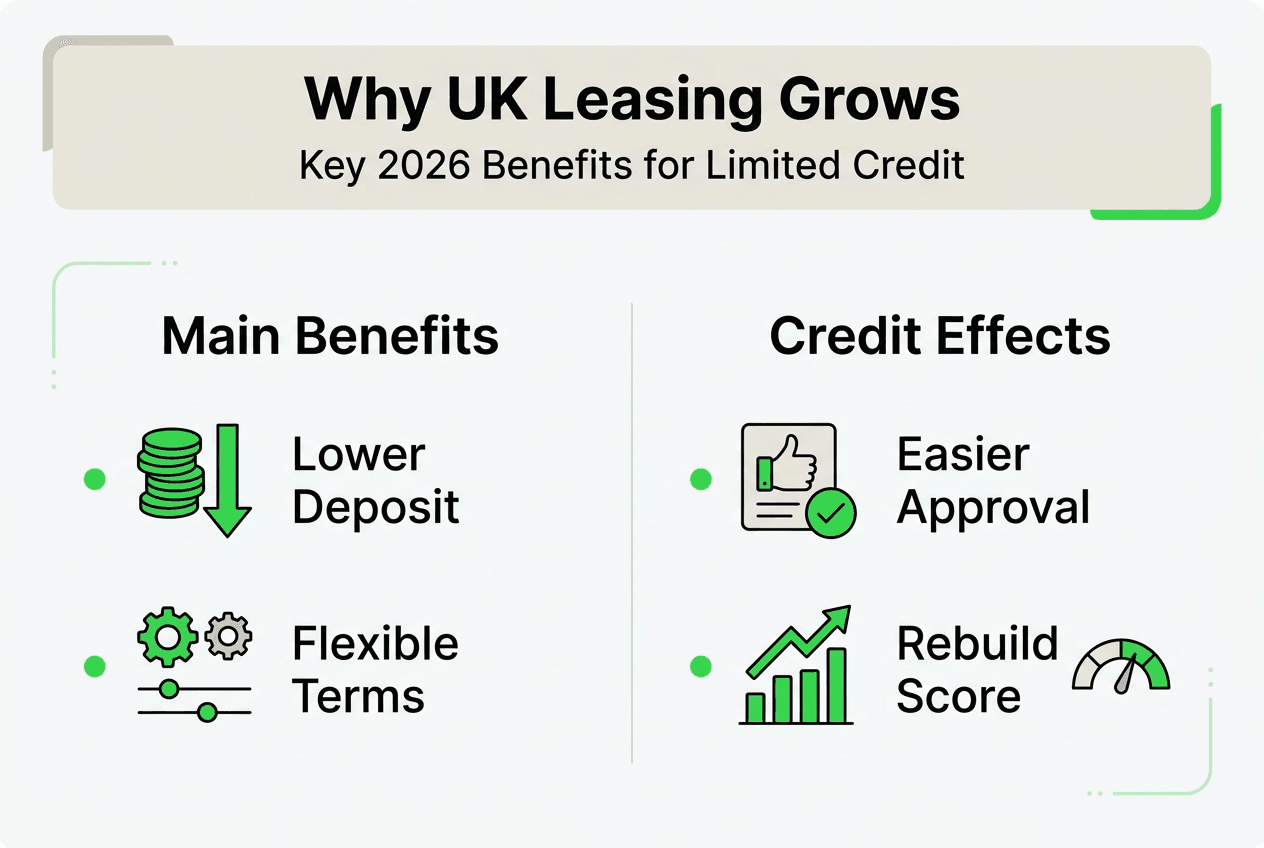
Comparison of leasing versus financing impacts:
| Factor | Leasing | Traditional Financing |
|---|---|---|
| Typical monthly cost | £200-350 (mid-range vehicle) | £280-450 (same vehicle) |
| Upfront deposit | £500-2,000 | £3,000-6,000 |
| Credit score impact | Positive with on-time payments | Positive with on-time payments |
| VAT reclaim (business) | 50-100% depending on vehicle type | Limited to specific circumstances |
| End of term obligation | Return vehicle, no resale hassle | Sell vehicle, manage depreciation loss |
This financial structure particularly benefits those in the early stages of business development or credit recovery. You maintain predictable monthly expenses without the shock of large repair bills, as many lease agreements include maintenance packages. This predictability aids budgeting accuracy, reducing the financial uncertainty that often derails recovery efforts.
Key cash flow advantages:
- Lower regular payments preserve working capital
- Predictable costs eliminate surprise repair expenses
- VAT reclaim opportunities for eligible businesses
- No depreciation risk affecting asset values
- Credit building through demonstrated payment reliability
Pro Tip: Set up a direct debit for your lease payments on the day after your salary or main income arrives. This automation ensures punctual payments that build credit history whilst removing the risk of missed payments due to oversight or cash flow timing issues.
Understanding how leasing helps manage cash flow and exploring short-term leasing benefits for bad credit can help you maximise these financial advantages.
Market growth and trends in UK asset finance supporting vehicle leasing
The UK asset finance market provides compelling evidence of leasing's growing popularity and trustworthiness among businesses and individuals. Asset finance new business grew by 1% in 2025, with SME lending rising 4% overall and 11% in December 2025, demonstrating sustained demand despite broader economic uncertainties. This growth reflects increasing confidence in asset finance as a viable funding mechanism, particularly among small and medium enterprises seeking to preserve capital whilst maintaining operational capacity.
The scale of this market is substantial. Asset finance supported over £24 billion in new business lending to UK SMEs throughout 2025, touching virtually every sector of the economy. Service industries, construction firms, and manufacturing operations all increasingly turn to leasing and asset finance to acquire the vehicles and equipment essential for their operations. This widespread adoption across diverse sectors underscores the model's versatility and effectiveness in meeting varied business needs.
Particularly noteworthy is the acceleration in the final quarter of 2025. The 11% growth in December signals strong momentum heading into 2026, suggesting that businesses view asset finance favourably when planning for the year ahead. This timing indicates confidence in both the economic outlook and the asset finance model itself, as businesses commit to multi-year agreements based on projected stability and growth.
UK asset finance statistics 2024-2025:
| Metric | 2024 | 2025 | Change |
|---|---|---|---|
| Total new business value | £23.8 billion | £24.0 billion | +1% |
| SME lending growth | Baseline | +4% | +4% |
| December month growth | Baseline | +11% | +11% |
| Primary sectors | Service, construction, manufacturing | Service, construction, manufacturing | Consistent |
This market expansion directly benefits individuals and small businesses with limited credit. As the asset finance sector grows and matures, competition increases among providers, driving innovation in approval criteria and product offerings. Specialist providers have emerged focusing specifically on applicants with challenged credit histories, recognising this underserved market segment represents significant opportunity. The result is more choice, better terms, and increased accessibility for those who might have been declined just a few years ago.
Market factors supporting accessibility:
- Growing provider competition improving terms and flexibility
- Specialist lenders focusing on alternative credit assessment
- Technology enabling faster application processing and decisions
- Increased acceptance of asset finance across business sectors
- Regulatory frameworks supporting fair lending practices
The data reinforces that leasing and asset finance have moved firmly into the mainstream of UK business funding. This normalisation reduces stigma and increases acceptance, making it easier for individuals and businesses to access vehicles regardless of their credit history. The market's continued growth into 2026 suggests this trend will strengthen further, with even more innovation and accessibility on the horizon.
Staying informed about leasing market growth in 2026 helps you understand the broader context and identify emerging opportunities in this evolving sector.
Explore flexible vehicle leasing options with FlexiAutoLease
If you've recognised your own situation in the challenges and opportunities discussed throughout this guide, now is the ideal time to explore how leasing can work for your specific circumstances. FlexiAutoLease specialises in providing accessible vehicle leasing solutions for individuals and small businesses with limited or poor credit histories, offering the flexible contract lengths and understanding approval processes that make vehicle access achievable regardless of past financial difficulties.

The FlexiAutoLease team understands that credit challenges don't define your current reliability or future potential. They work with you to find solutions that match your budget and needs, whether you're seeking a personal vehicle for daily commuting or commercial vehicles for business operations. Their personalised approach considers your unique situation rather than applying rigid criteria that exclude capable borrowers.
Pro Tip: Before applying, gather recent payslips, bank statements, and proof of address to streamline the approval process. Being prepared demonstrates organisation and reliability, potentially improving your terms.
Explore flexible vehicle leasing solutions designed specifically for your needs, or review bad credit leasing approval tips to maximise your chances of securing favourable terms.
"FlexiAutoLease transformed what seemed impossible into reality. Their team looked beyond my credit score to see my current stability, getting me into a reliable vehicle with terms I could actually manage."
Frequently asked questions
Is leasing possible with poor credit?
Yes, leasing is definitely possible with poor credit, though you may face higher deposits or interest rates compared to applicants with excellent credit. Many specialist providers now focus specifically on serving customers with challenged credit histories, using alternative assessment methods that consider current income stability and employment rather than solely relying on historical credit scores.
How does leasing help rebuild credit?
Leasing helps rebuild credit through consistent on-time payments that leasing companies report to credit reference agencies. Each punctual monthly payment adds a positive entry to your credit file, gradually improving your credit score over the lease term. This demonstrated reliability makes you more attractive to future lenders, potentially qualifying you for better rates when your current lease ends.
What are the advantages of short-term leases?
Short-term leases offer flexibility to upgrade vehicles regularly, typically every two to four years, allowing you to adapt to changing financial or business circumstances. They're particularly valuable if you're actively rebuilding credit, as shorter terms let you refinance into better rates sooner once your credit score improves. You also avoid being locked into lengthy commitments if your vehicle needs change.
Can businesses reclaim VAT on lease payments?
Yes, VAT-registered businesses can reclaim a portion of the VAT paid on lease rentals, with passenger cars typically qualifying for 50% reclaim and commercial vehicles potentially eligible for 100% depending on business use. This tax efficiency significantly reduces the net cost of leasing compared to outright purchase, improving cash flow and profitability. Consult your accountant to ensure you're maximising available reclaims for your specific situation.