

Many assume leasing a vehicle drains cash reserves or limits financial flexibility. The opposite is often true, particularly for self-employed professionals, small businesses and individuals navigating credit challenges. Leasing can preserve capital, introduce predictable monthly costs and unlock liquidity that fuels growth. This guide explains how leasing improves cash flow management, clarifies VAT reclaims and highlights accessible options for those with limited credit histories.
Table of Contents
- How Leasing Preserves Cash Flow And Capital
- How Leasing Improves Cash Flow Management For UK Small Businesses
- Leasing Advantages For Individuals With Bad Credit And Self-Employed Professionals
- Tax And Budgeting Considerations When Leasing A Vehicle For Business Use
- Explore Flexible Vehicle Leasing Options To Improve Your Cash Flow
- Frequently Asked Questions About Leasing And Cash Flow
Key takeaways
| Point | Details |
|---|---|
| Capital preservation | Leasing avoids large upfront outlays, freeing cash for daily operations or investment. |
| Budget predictability | Fixed monthly lease payments simplify forecasting and reduce financial uncertainty. |
| Accessibility | Operating leases suit those with bad credit better than traditional financing. |
| VAT reclaim | VAT-registered businesses can reclaim 50-100% VAT on lease payments depending on usage. |
| Flexibility | Short-term leases align with changing business needs without long-term capital ties. |
How leasing preserves cash flow and capital
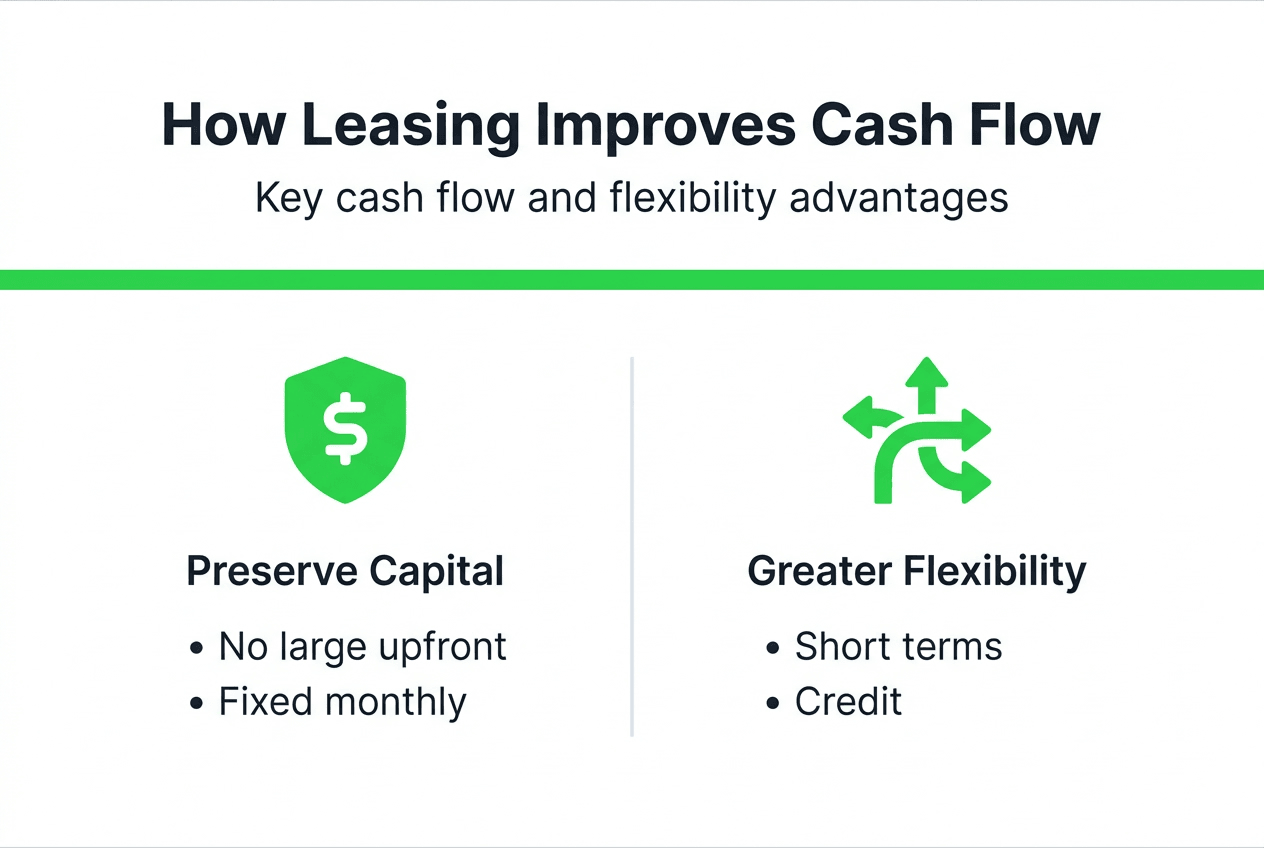
Purchasing a vehicle outright demands significant capital, tying up funds that could strengthen daily operations or fuel expansion. Leasing improves liquidity and preserves capital by avoiding these large upfront costs. Instead of depleting reserves, you spread the expense across manageable monthly payments. This approach proves especially valuable for sole traders, startups and small enterprises operating with limited working capital.
When cash remains accessible, you maintain the agility to seize opportunities, cover unexpected expenses or invest in revenue-generating activities. Leasing creates breathing room in your finances, enabling you to respond to market shifts without scrambling for emergency funds. For businesses with tight margins, this liquidity advantage can mean the difference between sustained growth and stalled progress.
Key cash flow benefits from leasing include:
- Eliminating the need for substantial down payments or outright purchase costs
- Maintaining cash reserves for payroll, inventory or marketing investments
- Avoiding depreciation risks associated with vehicle ownership
- Accessing newer, more reliable vehicles without capital strain
- Simplifying upgrade cycles as business needs evolve
"Leasing offers a powerful liquidity tool, enabling organisations to acquire essential assets while preserving capital for strategic priorities and operational resilience."
Exploring short-term leasing benefits reveals additional flexibility for those seeking to align vehicle costs with project timelines or seasonal demand. The financial breathing space leasing provides makes it a strategic choice rather than merely a financing alternative.
How leasing improves cash flow management for UK small businesses
Operating leases transform the economics of vehicle acquisition by spreading costs over time with lower monthly payments than outright purchase or traditional financing. This structure directly addresses the cash flow challenges small businesses face. Instead of absorbing a major expense in one quarter, you distribute the cost across months or years, smoothing financial peaks and valleys.
Fixed lease payments create budget predictability that simplifies planning. You know exactly what vehicle costs will be each month, eliminating surprises that disrupt forecasting. This consistency helps you allocate resources confidently across other priorities like hiring, equipment upgrades or marketing campaigns. Fixed monthly lease rentals aid predictable budgeting, reducing the financial uncertainty that plagues businesses with variable income streams.

For self-employed professionals and contractors, leasing preserves working capital needed to bridge payment gaps or cover irregular income patterns. You avoid the cash crunch of a large purchase whilst still accessing reliable transport. The monthly commitment feels manageable even during slower periods, and many leases include maintenance, road tax and breakdown cover, further stabilising your outgoings.
Pro Tip: When evaluating lease terms, prioritise agreements with fixed monthly costs that include servicing and maintenance. This transparency eliminates unexpected repair bills that can derail careful budgeting.
Key cash flow advantages include:
- Predictable monthly expenses that integrate seamlessly into budgets
- Preserved capital for income-generating activities or emergency reserves
- Reduced risk of vehicle-related financial shocks like major repairs
- Flexibility to upgrade vehicles as business grows without capital re-investment
- Simplified accounting with consistent, deductible business expenses
These benefits prove particularly relevant for car leasing bad credit options, where traditional financing might demand prohibitive deposits or interest rates. Leasing levels the playing field, enabling businesses to manage cash flow professionally regardless of credit history.
Leasing advantages for individuals with bad credit and self-employed professionals
Operating leases place ownership risk with the lessor rather than the lessee, making them more accessible than traditional financing for those with bad or limited credit histories. Unlike hire purchase or loans that scrutinise creditworthiness heavily, many leasing providers focus on affordability and payment reliability. This opens doors for self-employed individuals, contractors and small business owners who may struggle to demonstrate conventional credit strength.
Business contract hire requires lower upfront costs, easing acquisition for those with limited capital or credit. Where vehicle purchase might demand 20-30% deposits, leasing often requires minimal initial payments. Some providers even offer no deposit arrangements, eliminating the biggest barrier to vehicle access. This structure recognises that credit scores don't always reflect current income stability or business viability.
Key benefits for bad credit or self-employed lessees include:
- Reduced emphasis on credit history compared to traditional car finance
- Lower initial deposits that preserve scarce capital reserves
- Soft credit checks that don't impact existing credit scores
- Transparent approval criteria focused on affordability rather than past credit events
- Flexible lease terms aligned with variable income patterns
- Opportunity to build payment history without ownership commitment
Pro Tip: Consider no deposit leasing options to minimise initial financial burden. Spreading the entire cost across monthly payments protects your cash reserves and avoids the scramble to find upfront funds.
For self-employed professionals, leasing accommodates the income variability that traditional lenders often penalise. You can select lease terms matching your business cycle, whether that's 6 months for project-based work or 24 months for established operations. This flexibility, combined with accessibility, makes leasing a practical solution when conventional financing routes prove frustrating or impossible.
Exploring van leasing bad credit approval options demonstrates how commercial vehicle access remains achievable even with credit challenges. The combination of no deposit leasing benefits and flexible terms creates genuine opportunity for those rebuilding credit or establishing new businesses.
Tax and budgeting considerations when leasing a vehicle for business use
VAT reclaim rules significantly affect the true cost of leasing for VAT-registered businesses. VAT-registered businesses can reclaim 100% VAT on lease payments for vehicles used solely for business, or 50% if partly private. This tax treatment reduces effective costs substantially compared to personal leasing or outright purchase, improving cash flow by lowering your net monthly outlay.
Understanding which scenario applies to your situation ensures you maximise financial advantages. The table below clarifies VAT reclaim entitlements:
| Usage scenario | VAT reclaim percentage | Practical impact |
|---|---|---|
| 100% business use (no private mileage) | 100% of VAT on lease payments | Lowest effective monthly cost for VAT-registered businesses |
| Mixed business and private use | 50% of VAT on lease payments | Moderate cost reduction, most common scenario for sole traders |
| Personal use only | 0% VAT reclaim | Standard lease cost, no tax advantage |
Beyond VAT, several budgeting factors influence how leasing affects your cash flow:
- Mileage limits specified in agreements, with excess charges typically 5-20p per mile
- Included services like road tax, maintenance and breakdown cover that stabilise costs
- End-of-lease condition requirements that may incur repair charges
- Early termination penalties if business circumstances change
- Seasonal payment structures some providers offer to match income patterns
Mileage penalties deserve particular attention. Exceeding your agreed annual limit triggers per-mile charges that accumulate quickly, potentially creating an unexpected cash flow hit at lease end. Track mileage monthly and select realistic limits during initial negotiations. It's generally cheaper to lease higher mileage allowances upfront than pay excess charges later.
Similarly, understanding what's included in your monthly payment prevents budgeting surprises. All-inclusive leases covering servicing, tyres and consumables offer superior cash flow predictability compared to bare leases requiring separate maintenance budgets. This transparency matters enormously for small businesses operating on thin margins.
Reviewing your car lease tax checklist before committing ensures you've considered all financial implications. Proper planning around VAT reclaim and mileage monitoring transforms leasing from a simple vehicle solution into a strategic cash flow management tool.
Explore flexible vehicle leasing options to improve your cash flow
If preserving capital, stabilising monthly costs and accessing vehicles without credit barriers align with your financial priorities, exploring tailored leasing solutions makes strategic sense. Flexi Auto Lease specialises in flexible vehicle leasing options designed specifically for individuals and businesses facing credit challenges or seeking maximum financial flexibility. Our approach emphasises accessibility, transparency and cash flow preservation.

We understand that limited credit history or self-employment shouldn't block access to reliable transport. Our bad credit car leasing solutions use soft credit checks and focus on affordability, not past financial events. With no deposit leasing available and lease terms from 6 to 24 months, you can align vehicle costs perfectly with your business cycle or personal circumstances.
Pro Tip: Choosing the right lease term can further aid cash flow management. Shorter terms suit project-based work or uncertain income, whilst longer terms reduce monthly payments for established operations.
Our all-inclusive pricing covers road tax, maintenance and breakdown assistance, giving you complete cost certainty. Nationwide delivery, quick approval and personalised service ensure you're driving within days, not weeks. Explore our options today to discover how the right leasing arrangement can transform your cash flow management.
Frequently asked questions about leasing and cash flow
How does leasing help with monthly cash flow management?
Leasing spreads vehicle costs into fixed monthly payments instead of requiring large upfront capital. This predictability simplifies budgeting and preserves cash reserves for other operational needs or growth investments. Included services like maintenance eliminate unexpected repair bills that disrupt cash flow.
Can I lease a vehicle with bad credit or no credit history?
Yes, operating leases often prove more accessible than traditional financing for those with limited or poor credit. Many providers use soft credit checks and focus on current affordability rather than past credit events. Bad credit car leasing options exist specifically for this audience, with lower deposits and flexible terms.
What VAT reclaim options are available for business vehicle leases?
VAT-registered businesses can reclaim 100% of VAT on lease payments when vehicles are used exclusively for business, or 50% for mixed business and private use. This significantly reduces effective leasing costs compared to non-VAT scenarios, improving cash flow by lowering net monthly outlays.
Are there any hidden costs to watch for in leasing agreements?
Mileage excess charges represent the most common surprise cost, typically 5-20p per exceeded mile. Also review end-of-lease condition requirements, as wear-and-tear beyond fair use may incur charges. Early termination penalties apply if you need to exit the lease before the agreed term ends.
How important is mileage limit tracking in managing cash flow?
Extremely important. Exceeding agreed mileage triggers per-mile charges that accumulate across the lease term, creating a potentially substantial bill at lease end. Track mileage monthly and select realistic annual limits during negotiations. Adjusting limits upfront typically costs less than paying excess charges later, protecting your cash flow from unexpected hits.