

Leasing a vehicle usually seems difficult for new or self-employed individuals due to credit concerns, but flexible leasing solutions offer new employment individuals access to vehicles without harming credit scores. This guide explains how UK leasing works for new employment in 2026 and how to apply successfully, unlocking opportunities previously thought inaccessible.
Table of Contents
- Introduction To Leasing With New Employment In The UK
- Employment And Credit Requirements In Traditional Leasing
- How Soft And No Credit Checks Facilitate Vehicle Leasing
- Financial Terms And All-Inclusive Leasing Benefits
- Leasing Approval Timelines And Process
- Common Misconceptions About Credit Checks In Leasing
- Practical Advice And Next Steps For New Employees Seeking To Lease
- How Flexiautolease Supports New Employment Leasing In 2026
- Frequently Asked Questions
Key takeaways
| Point | Details |
|---|---|
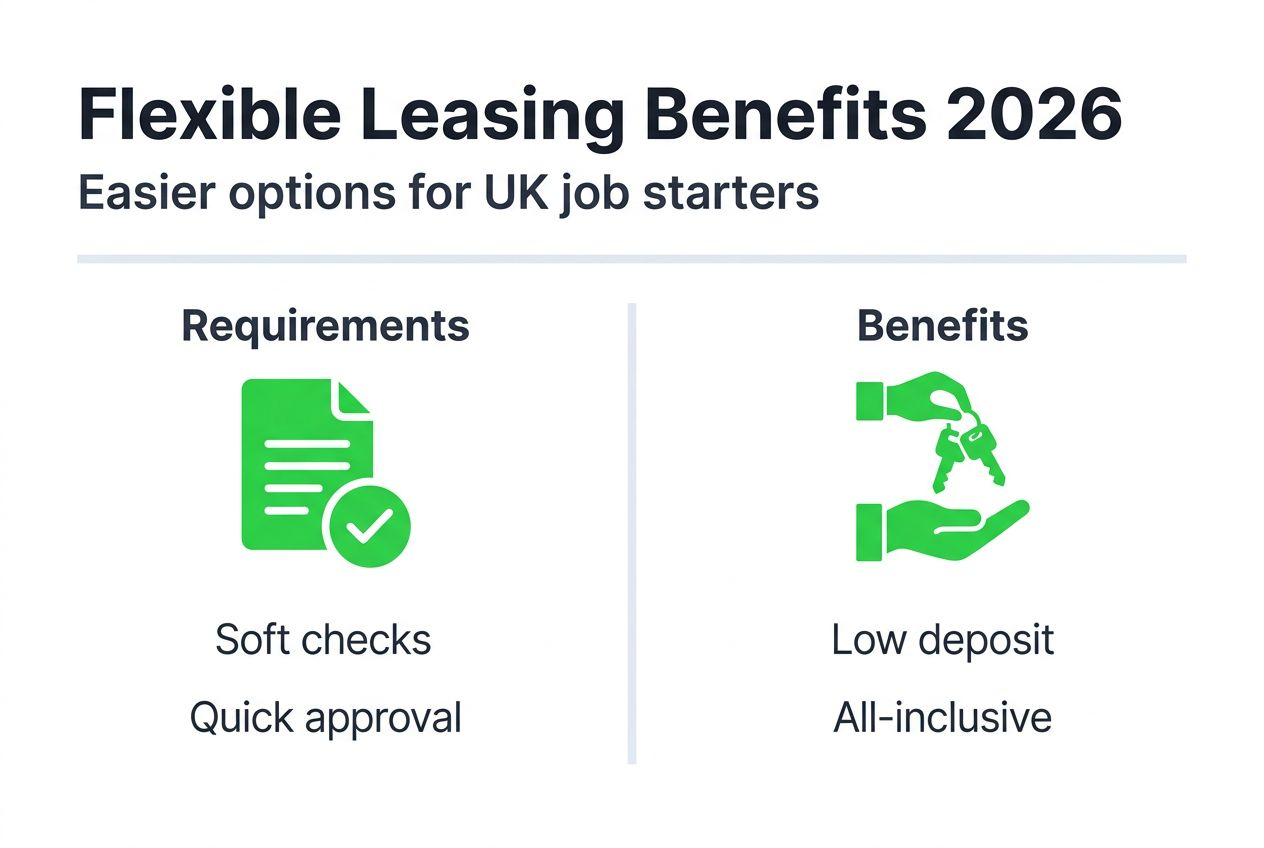
| Flexible leasing uses soft or no credit checks | Protects your credit score during the application process |
| Traditional leases require longer employment history | Often demand 6 to 12 months of stable income with hard credit checks |
| All-inclusive packages simplify budgeting | Cover tax, insurance, and maintenance in monthly payments |
| Approval happens within days | New employees often receive decisions in 1 to 5 days |
| Proper documentation improves approval chances | Organised proof of employment and income speeds up processing |
Introduction to leasing with new employment in the UK
Vehicle leasing lets you pay monthly to use a car without ownership, offering flexibility and lower upfront costs compared to purchasing. However, new or self-employed individuals face significant barriers when pursuing traditional leasing arrangements. Strict credit checks examine full credit histories, and providers typically require 6 to 12 months of continuous employment to demonstrate financial stability.
New employment and self-employment lack the credit and income history traditionally needed for approval, creating frustration for individuals who need reliable transport to start or maintain their careers. Banks and mainstream leasing companies view recent employment changes as increased risk, leading to automatic rejections or unfavourable terms. The lack of established credit records compounds these challenges, leaving many believing vehicle leasing remains out of reach.
Flexible leasing providers specifically cater to these underserved groups, removing traditional barriers and making vehicle access achievable. These services focus on current circumstances rather than extensive credit histories, recognising that recent employment changes don't necessarily indicate financial unreliability. Understanding the key features that set flexible leasing apart helps new employees make informed decisions:
- Short lease terms ranging from 6 to 24 months offer commitment flexibility
- All-inclusive pricing bundles road tax, insurance, and maintenance into predictable monthly costs
- Soft or no credit checks protect credit scores whilst still assessing affordability
- Quick approval processes recognise urgent transport needs for new employment
- Transparent contracts clarify mileage limits and early termination options upfront
These features directly address the pain points new and self-employed individuals experience when seeking traditional leases, creating accessible pathways to vehicle ownership that align with modern employment patterns.
Employment and credit requirements in traditional leasing
Traditional leases ask for 6 to 12 months continuous employment to prove income stability, documentation that new employees simply cannot provide. Hard credit checks access full credit reports during application, possibly lowering scores and creating lasting impacts on future borrowing ability. Providers demand comprehensive proof of income and address, challenging requirements for individuals recently hired or newly self-employed who haven't accumulated sufficient paperwork.
Traditional leases require 6 to 12 months stable employment and hard credit checks impacting approval for new employment lessees, creating systematic exclusion from mainstream vehicle access. The perceived risk associated with new employment status means providers often reject applications automatically or demand substantial deposits that negate the affordability benefits of leasing. Understanding these strict requirements reveals why so many capable individuals find themselves unable to secure traditional leases:
- Continuous employment verification spanning several months remains standard practice
- Hard credit inquiries leave visible marks on credit files for up to two years
- Proof of stable address history may exclude those recently relocated for work
- Income verification demands payslips or tax returns unavailable to newly employed
- Risk assessment models penalise employment gaps or career transitions
New employment status usually means less documentation and higher perceived risk in traditional underwriting systems, regardless of actual financial capability or responsible money management. These barriers disproportionately affect individuals making positive life changes like starting new careers or launching entrepreneurial ventures. Recognising these limitations is essential before seeking a lease, as it helps direct efforts towards providers offering genuinely flexible alternatives rather than repeatedly facing rejection.
Pro Tip: Before applying for any lease, verify whether the provider uses hard or soft credit checks to avoid unnecessary damage to your credit score from multiple applications.
How soft and no credit checks facilitate vehicle leasing
The difference between hard and soft credit checks fundamentally changes leasing accessibility for new employment individuals. Soft checks verify creditworthiness without leaving a mark on credit reports, allowing providers to assess financial responsibility whilst protecting applicants' credit scores. This distinction matters enormously because soft credit checks do not affect credit scores, increasing approval chances for those with short employment history who may need to apply to multiple providers.
No credit check leases rely more heavily on income verification and proof of current employment rather than historical credit performance. These arrangements recognise that recent employment changes or limited credit histories don't necessarily predict future payment behaviour. Providers using alternative criteria for self-employed applicants might examine bank statements showing consistent income patterns, demonstrating financial stability through actual cash flow rather than credit scores alone.
These checks increase accessibility and protect credit scores during leasing applications, fundamentally shifting the balance towards evaluating present circumstances. The practical benefits extend beyond just approval odds:
- Application rejections don't create negative credit file entries
- Multiple provider comparisons become feasible without score damage
- Recent employment becomes less of an automatic disqualification
- Alternative income evidence gains acceptance for self-employed applicants
- Financial privacy improves as full credit histories remain unexamined
Flexible providers understand that someone newly employed in a stable role represents manageable risk when current income sufficiently covers monthly payments. This approach particularly benefits individuals with excellent money management skills but limited formal credit histories, such as those previously paying cash or recently arrived in the UK. SUV leasing with limited credit becomes achievable through these alternative assessment methods.

Pro Tip: Request confirmation that any credit check performed will be soft rather than hard before authorising a leasing provider to access your credit file.
Financial terms and all-inclusive leasing benefits
All-inclusive pricing bundles monthly payments covering tax, insurance, and maintenance into one predictable cost, eliminating the financial surprises that often derail budgets for new employees still establishing savings. This consolidated approach helps new employees budget without unexpected expenses like MOT failures, tyre replacements, or insurance renewals that create cash flow challenges. Various UK leasing models offer flexible lease terms from 6 to 24 months, allowing alignment with probation periods, contract lengths, or business development timelines.
No deposit and short-term leases provide additional accessibility by removing the substantial upfront payments that traditional arrangements demand, often running into thousands of pounds. Clarity and transparency in costs improve confidence for new lessees who need certainty about their financial commitments whilst building emergency funds and adjusting to new income levels. The financial benefits of all-inclusive leasing extend across multiple dimensions:
- Predictable monthly budgeting without variable maintenance costs
- Road tax inclusion eliminates annual lump sum payments
- Comprehensive insurance coverage protects against liability exposure
- Maintenance and servicing prevent unexpected garage bills
- Breakdown cover ensures continued mobility during mechanical issues
No deposit leasing benefits particularly help individuals directing available cash towards securing accommodation, purchasing work equipment, or building business inventory rather than tying funds up in vehicle deposits. The table below illustrates typical monthly cost differences between all-inclusive and basic leasing packages:
| Package Type | Monthly Payment | Road Tax | Insurance | Maintenance | Total Monthly Cost |
|---|---|---|---|---|---|
| Basic lease | £250 | £15 | £80 | Variable | £345+ |
| All-inclusive | £380 | Included | Included | Included | £380 |
The all-inclusive model removes financial uncertainty, making it easier to commit confidently to a lease knowing exactly what each month will cost. This transparency proves invaluable during the early months of new employment when income patterns are still stabilising and unexpected costs can create serious hardship.
Pro Tip: Calculate your total transport costs including fuel to ensure the all-inclusive monthly payment fits comfortably within your post-tax income, leaving room for savings and emergencies.
Leasing approval timelines and process
Navigating the leasing process efficiently requires understanding each step and preparing accordingly. Following this structured approach maximises approval chances whilst minimising delays:
- Check eligibility and acceptable income proofs with providers before gathering documentation to ensure your circumstances align with their criteria
- Prepare essential documents including employment proof such as offer letters or contracts, valid UK driving licence, recent utility bills or tenancy agreements for residency, and passport or other photo identification
- Apply with providers offering soft or no credit check leasing, comparing terms and vehicle options across multiple companies to find the best match for your needs
- Await approval within 1 to 5 days, during which providers verify your documentation and assess affordability based on stated income
- Carefully review lease agreements for terms covering mileage allowances, early termination penalties, maintenance responsibilities, and insurance excess amounts before signing
- Arrange vehicle delivery or collection as per options offered, coordinating timing with your work schedule and ensuring you understand handover procedures
Short-term vehicle leasing approval for new employment often completes in 1 to 5 days, enabling rapid vehicle access crucial for individuals who need transport to start new roles or fulfil client commitments. This speed contrasts sharply with traditional leasing that might take weeks whilst providers conduct extensive employment and credit verification.
The efficiency of modern flexible leasing stems from streamlined digital applications and automated affordability assessments that replace lengthy manual underwriting processes. Quick turnaround times recognise that transport needs are often urgent, particularly when new employment depends on reliable vehicle access. Understanding leasing alternatives UK 2026 helps identify providers offering the fastest processing for your specific circumstances.
Common misconceptions about credit checks in leasing
Widespread misunderstandings about credit checks create unnecessary fear that prevents capable individuals from pursuing flexible leasing options. Addressing these misconceptions directly removes barriers to informed decision making.
Soft credit checks do not reduce credit scores, unlike hard checks which can lower scores by several points and remain visible on credit files for up to two years. This fundamental difference means exploring multiple flexible leasing providers carries no credit score penalty, encouraging comprehensive comparison shopping. No credit check does not mean no financial assessment occurs, as providers still verify income and employment to ensure affordability.
Lease approvals often consider income and employment proof more heavily than credit history for new employment applications, recognising that current earning capacity matters more than past financial patterns. This shift in assessment criteria opens opportunities for individuals whose credit files don't reflect their actual financial responsibility or capability. Credit checks during leasing are infrequent and generally only occur at application, not throughout the lease term unless significant payment issues arise.
Understanding leasing criteria helps avoid unnecessary application fears that keep capable lessees from accessing vehicles they can genuinely afford. Key misconceptions to dismiss include:
- Belief that any credit check automatically damages your score
- Assumption that limited credit history equals automatic rejection
- Fear that applying to multiple providers creates compounding credit damage
- Misunderstanding that soft checks access the same detailed information as hard checks
- Concern that new employment always triggers automatic refusal
These myths persist partly because traditional lenders do operate under stricter credit-dependent models, but flexible leasing providers deliberately design alternative assessment approaches. Van leasing credit approval demonstrates how commercial vehicle access follows similar principles, prioritising business income verification over personal credit histories for self-employed applicants.
Practical advice and next steps for new employees seeking to lease
Turning knowledge into action requires systematic preparation and strategic provider selection. Following these practical steps positions you for successful leasing approval:
- Gather essential documents well in advance, including proof of employment or self-employment such as contracts, offer letters, or client agreements, valid photo identification, recent proof of address dated within three months, and bank statements showing consistent income deposits
- Research and choose providers focusing on soft or no credit checks and all-inclusive pricing, reading reviews and comparing terms across at least three companies to identify the best fit for your circumstances
- Prepare for quick approval by organising accurate information and ensuring contact details are current so providers can reach you promptly with questions or decisions
- Read lease agreements thoroughly for mileage limits that match your expected usage, early termination terms in case circumstances change, maintenance responsibilities to understand what's covered, and insurance excess amounts you'd pay for damage claims
- Communicate actively with the leasing provider throughout the process, asking questions about anything unclear and promptly providing any additional documentation requested to avoid processing delays
This methodical approach demonstrates financial organisation that reassures providers whilst protecting your interests through informed decision making. The flexible car lease checklist UK provides additional criteria for evaluating providers and ensuring contracts meet your needs.
Successful leasing depends on matching vehicle choice to genuine needs rather than aspirations, keeping monthly costs comfortably within your budget to avoid payment stress. Consider your daily commute distance, parking availability, fuel efficiency priorities, and whether you need commercial vehicle capacity for work purposes. These practical considerations matter more than brand prestige or premium features that inflate monthly costs.
Pro Tip: Request a detailed breakdown of what your all-inclusive monthly payment covers before signing, ensuring you understand exactly which costs are included and which remain your responsibility.
How flexiautolease supports new employment leasing in 2026
FlexiAutoLease offers flexible leasing solutions designed specifically for new and self-employed UK lessees who face barriers with traditional providers. The service uses soft credit checks ensuring no negative impact on credit scores, removing the fear that exploring vehicle options might damage future borrowing ability. All-inclusive monthly pricing simplifies budgeting by bundling road tax, insurance, and maintenance into one predictable payment.

Approval turnaround typically occurs within days rather than weeks, providing quick vehicle access crucial for individuals starting new roles or building businesses. The platform supports various lease terms from 6 to 24 months with transparent contracts clearly outlining mileage allowances, maintenance coverage, and early termination options. Nationwide delivery options mean you can arrange vehicle handover at your convenience, whether at home or work, without travelling to distant collection centres. This comprehensive approach addresses every major pain point new employment lessees encounter, creating genuinely accessible vehicle leasing that works around your circumstances rather than demanding you meet rigid traditional criteria. Explore available vehicles and start your application at FlexiAutoLease to experience how flexible leasing removes barriers to vehicle access.
Frequently asked questions
Can I lease a vehicle with just a few weeks of new employment?
Flexible leasing providers use soft credit checks and alternative income proofs to approve new employment lessees quickly, often accepting employment contracts or offer letters as sufficient documentation. Some may accept as little as a few weeks' employment depending on your income level and the documentation you can provide demonstrating stable earning capacity.
Will applying for a lease affect my credit score?
Soft credit checks used in flexible leasing do not affect your credit score, allowing you to explore multiple providers without penalty. Hard credit checks typical in traditional leasing can temporarily lower scores by several points and remain visible on credit files for up to two years.
What documents do I need to lease a car with new employment?
You'll need proof of your new or self-employment such as contracts or offer letters, valid UK driving licence, proof of residency like recent utility bills, and identification documents such as a passport. Organising these early streamlines the approval process and demonstrates financial responsibility to providers.
How long does the leasing approval process usually take?
Most flexible leasing approvals take between one and five days, significantly faster than traditional leasing which might require weeks of verification. Quick approvals help new employees start driving without long delays that could jeopardise job starts or client commitments.