

Securing a commercial vehicle can feel impossible when you're running a small business with limited or poor credit history. You need that van or truck to keep operations moving, but traditional lenders often slam the door before you've even explained your situation. The good news is that flexible leasing options specifically designed for businesses with credit challenges exist across the UK, and they're more accessible than you might think. This guide walks you through practical steps to prepare, apply, and successfully secure a commercial vehicle lease, even when your credit file isn't perfect.
Table of Contents
- Key takeaways
- Understanding leasing options for commercial vehicles with bad credit
- Preparing to lease: essential requirements and improving your chances
- Step-by-step guide: how to lease commercial vehicles with limited credit
- Common challenges, mistakes and how to avoid them
- Explore flexible commercial vehicle leasing options today
- Frequently asked questions about leasing commercial vehicles with bad credit
Key Takeaways
| Point | Details |
|---|---|
| Understanding leasing options | Not all leasing arrangements treat credit history the same, so target providers who offer flexible solutions for businesses with poor credit. |
| Flexible deposits and shorter terms | Flexible leasing solutions often accept higher deposits and shorter contract lengths to improve approval chances. |
| Prepare essential documents | Having proof of income, identification, and business documentation ready speeds up approval. |
| Compare leasing with hire purchase | Compare leasing with hire purchase to choose the option that best fits cash flow and ownership goals. |
Understanding leasing options for commercial vehicles with bad credit
Not all leasing arrangements treat credit history the same way, and understanding your options helps you target providers most likely to approve your application. Bad credit van leasing explained offers flexible UK solutions for poor credit customers, opening doors that traditional finance keeps locked.
Contract hire represents the most common commercial leasing structure. You pay monthly fees to use the vehicle for a fixed period, then return it at the end. This arrangement typically requires a deposit and includes maintenance packages, making budgeting straightforward. Personal contract hire works similarly but caters to sole traders and self-employed individuals rather than limited companies. Lease purchase sits somewhere between leasing and buying, you make payments toward eventual ownership, which some providers find less risky when credit scores are low.
Flexible leasing solutions specifically target businesses with credit challenges by adjusting their risk assessment criteria. These providers focus on current income and business viability rather than historical credit mistakes. They often accept higher deposits in exchange for approval, offer shorter contract lengths to reduce their exposure, and provide more generous mileage allowances to suit commercial usage patterns.
Several key factors influence your leasing experience:
- Deposit amounts typically range from one to three months' payments, with higher deposits often securing better approval odds for poor credit applicants
- Contract length flexibility allows you to choose terms from 6 to 24 months, with shorter periods generally easier to approve
- Mileage limits must align with your business needs, as exceeding them triggers expensive penalty charges
- Maintenance inclusion varies between agreements, with comprehensive packages reducing unexpected costs
Understanding terminology prevents confusion when comparing offers. The initial payment refers to your upfront deposit, whilst monthly rentals cover your regular payments. Excess mileage charges apply when you drive beyond agreed limits, and early termination fees penalise breaking contracts before completion. Fair wear and tear defines acceptable vehicle condition at return, protecting you from unreasonable damage charges.
Preparing to lease: essential requirements and improving your chances
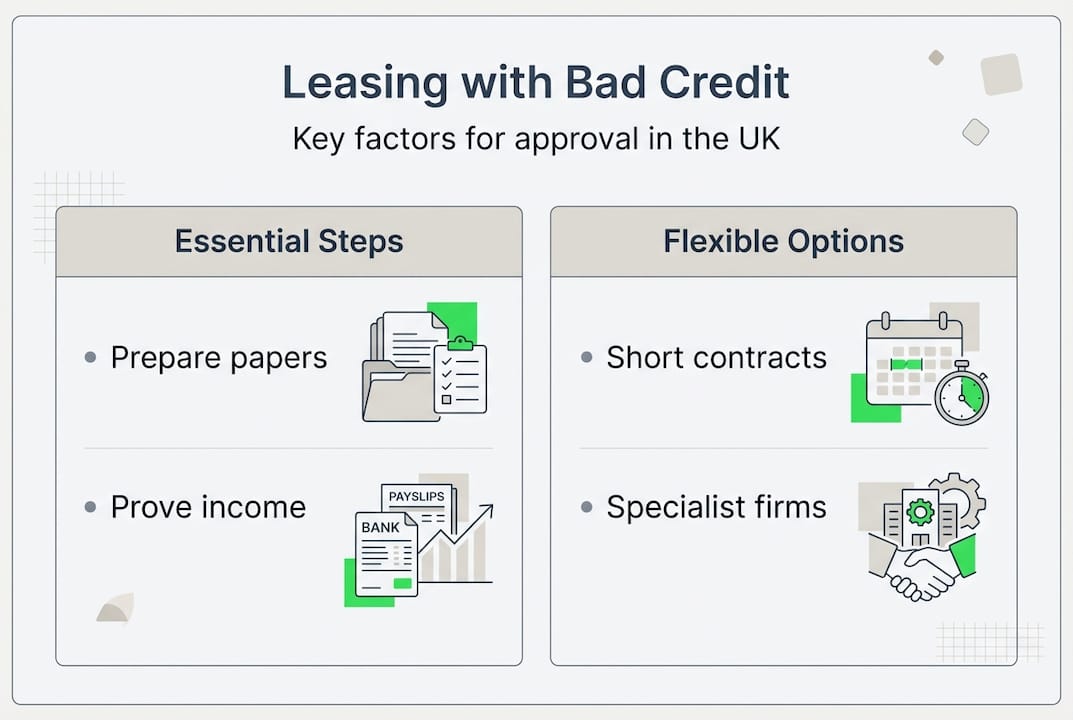
Preparation separates successful applications from rejected ones, especially when credit history works against you. Lessors want evidence that you can afford payments and genuinely need the vehicle for business purposes, so gathering the right documentation before applying demonstrates professionalism and speeds up approval.
Most providers request similar core documents. You'll need proof of income, which for self-employed applicants means recent tax returns, bank statements showing regular deposits, or accountant-verified income declarations. Personal identification includes driving licence, passport, and proof of address dated within three months. Business documentation varies by structure, sole traders need business bank statements and any relevant trading licences, whilst limited companies must provide incorporation certificates and recent accounts.
Leasing for new businesses clarifies flexible UK options and documentation needs, particularly helpful if you've recently started trading and lack extensive financial history.
Improving your approval chances doesn't require perfect credit, but strategic preparation helps. Register on the electoral roll at your current address, as this simple step boosts credit scores and confirms residency. Check your credit report for errors and dispute any inaccuracies before applying. Close unused credit accounts to reduce available credit, which some lessors view as potential future debt. If possible, pay down existing balances to improve your debt-to-income ratio.

Presenting business viability matters as much as personal finances. Prepare a brief explanation of your business model, customer base, and why the vehicle is essential for operations. Highlight stable contracts or regular clients that demonstrate ongoing income. If you've had credit issues in the past, a honest explanation showing how circumstances have changed can help assessors see beyond the numbers.
Choosing flexible contract lengths suits both your budget and approval prospects. Shorter terms mean lower total commitment, making lessors more comfortable approving applicants with uncertain credit. They also let you upgrade or change vehicles more frequently as your business grows.
Pro Tip: Maintain detailed vehicle usage logs for at least three months before applying, showing delivery routes, client visits, or job site travel. This evidence proves business necessity to lessors and strengthens applications where credit history alone might not convince assessors.
Step-by-step guide: how to lease commercial vehicles with limited credit
Following a structured approach transforms what feels overwhelming into a manageable process. Each step builds toward securing the vehicle your business needs whilst working within credit constraints.
-
Identify your specific vehicle requirements and realistic budget. List essential features like payload capacity, fuel type, and body style. Calculate maximum affordable monthly payments including insurance and fuel costs. Consider whether you need refrigeration, tail lifts, or other specialist equipment that affects both approval and pricing.
-
Research providers specialising in poor credit commercial leasing. Not all companies advertise this focus, so look for terms like "bad credit accepted," "flexible approval," or "no credit check" in their marketing. Read customer reviews specifically mentioning credit challenges to gauge realistic approval chances.
-
Apply with multiple providers simultaneously to compare offers. Each application triggers a credit check, but applying within a short window typically counts as a single inquiry on your credit file. Provide identical information across applications to ensure fair comparison.
-
Review contract terms thoroughly before signing anything. Check the total amount payable over the contract period, not just monthly payments. Identify penalty clauses for early termination, excess mileage, and damage beyond fair wear. Confirm what maintenance and repairs are included versus your responsibility.
-
Negotiate terms that suit your situation. Request flexible mileage allowances if you anticipate variable usage. Ask about shorter initial contracts with extension options, reducing commitment whilst proving your reliability. Enquire whether higher deposits can reduce monthly payments or improve approval odds.
-
Complete the agreement and arrange vehicle collection or delivery. Inspect the vehicle carefully before accepting it, documenting any existing damage with photos. Understand the return process and condition requirements from day one to avoid surprises later.
Pro Tip: Negotiate flexible mileage allowances upfront based on realistic projections rather than hoping to stay within low limits. Excess mileage charges typically cost far more per mile than including higher allowances in your original contract.
Comparing leasing against hire purchase helps you choose the best route for your circumstances:
| Factor | Leasing | Hire purchase |
|---|---|---|
| Credit requirements | More flexible, some providers use soft checks | Stricter credit assessment required |
| Ownership | Return vehicle at contract end | Own vehicle after final payment |
| Monthly payments | Generally lower | Typically higher |
| Mileage limits | Usually included | No restrictions |
| Maintenance | Often included in package | Your responsibility |
| Early termination | Penalty fees apply | May refinance or settle early |
Leasing vs hire purchase highlights pros and cons to help choose the best route for limited credit, showing how each option affects both approval chances and long-term costs.
Common challenges, mistakes and how to avoid them
Even well-prepared applications hit obstacles, but knowing common pitfalls helps you navigate around them before they derail your leasing journey. Most problems stem from misunderstandings, incomplete information, or unrealistic expectations rather than insurmountable credit issues.
Incomplete applications top the rejection list. Missing documents, unclear income evidence, or vague business descriptions give assessors easy reasons to decline. Double-check every requirement before submitting, and provide more documentation than requested rather than less. If you're self-employed without formal accounts, bank statements showing consistent deposits work better than estimates or projections.
Misunderstanding contract terms causes expensive surprises later. Many applicants focus solely on monthly payments whilst ignoring total contract cost, mileage limits, or maintenance exclusions. Read the entire agreement, not just the summary page. Question anything unclear before signing, as verbal promises mean nothing without written confirmation.
Neglecting mileage limits triggers penalty charges that can exceed your monthly payment. Business usage often exceeds personal driving patterns, so calculate realistic annual mileage based on actual routes and client locations. Build in a buffer for unexpected jobs or route changes rather than hoping to stay within tight limits.
Flexible contracts reduce risk of penalties or early termination charges by letting you adjust terms as circumstances change. Shorter initial periods mean less commitment if business conditions shift. Some providers allow mileage adjustments mid-contract or offer extension options without reapplication.
Choosing flexible contract length options is crucial to avoid financial strain and rejection. Shorter terms reduce lessor risk whilst giving you room to prove reliability before committing to longer agreements.
Clear communication prevents most problems before they start. Ask questions during the application process rather than making assumptions. Explain your business situation honestly, including any credit issues and how you've addressed them. Request written confirmation of agreed terms, especially regarding mileage, maintenance, and early termination options.
Thorough document checks before submission catch errors that might trigger rejection. Verify that income figures match across all documents, addresses are consistent and current, and business details align with official records. Ensure signatures and dates are complete, as missing information often delays processing or prompts automatic decline.
Other frequent mistakes include:
- Applying for vehicles beyond realistic budget, hoping approval will somehow make payments affordable
- Ignoring insurance costs, which for commercial vehicles often exceed personal car premiums
- Failing to maintain the vehicle properly, leading to excessive damage charges at return
- Not documenting vehicle condition at collection, making it impossible to dispute damage claims later
Explore flexible commercial vehicle leasing options today
You've learned how to prepare, apply, and navigate the leasing process despite credit challenges. Now it's time to put that knowledge into action with providers who understand your situation.

Flexi Auto Lease specialises in flexible commercial vehicle leasing designed for UK businesses with limited or poor credit history. Our soft credit checks mean applying won't damage your score, whilst our 6 to 24 month contract options give you the flexibility to match terms to your business needs. With nationwide delivery, all-inclusive pricing covering road tax and maintenance, and quick approval processes, you could be driving your commercial vehicle within days. We understand that past credit issues don't define your current business capability, and our personalised approach focuses on your ability to afford payments rather than historical mistakes. Browse our wide selection of vans and trucks, apply online with clear guidance at every step, and access the vehicle your business needs without the credit barriers that traditional lenders impose.
Frequently asked questions about leasing commercial vehicles with bad credit
Can you lease commercial vehicles with poor credit?
Yes, specialist providers offer bad credit van leasing options across the UK. These companies assess current income and business viability rather than relying solely on credit scores, making approval possible even with past financial difficulties. Higher deposits or shorter contract terms may apply, but access remains available.
What documents do I need to apply for a lease?
You'll need personal identification including driving licence and proof of address, income evidence such as recent bank statements or tax returns, and business documentation like trading licences or incorporation certificates. Self-employed applicants should prepare at least three months of bank statements showing regular business income. Having all documents ready before applying speeds up the approval process.
How does lease approval differ from hire purchase?
Leasing typically uses more flexible approval criteria because you're renting rather than buying, reducing the provider's risk. Many leasing companies use soft credit checks that don't affect your score, whilst hire purchase usually requires full credit assessment. Leasing focuses on your ability to make monthly payments, whereas hire purchase evaluates your capacity to eventually own the vehicle.
Are there flexible contracts available for bad credit?
Flexible contracts specifically help applicants with poor credit by offering shorter terms from 6 to 24 months, reducing long-term commitment. These agreements often include adjustable mileage allowances and comprehensive maintenance packages. Shorter initial contracts let you prove reliability before committing to longer terms, whilst flexible options accommodate changing business needs.
What happens if I exceed lease mileage limits?
Exceeding agreed mileage triggers excess charges, typically ranging from 10p to 25p per mile depending on vehicle type and contract terms. These costs add up quickly on commercial vehicles with high usage. You can usually negotiate higher mileage allowances upfront for less than excess charges cost, or some providers allow mid-contract adjustments if your needs change.
How quickly can I get approved and receive a commercial vehicle?
Approval timescales vary by provider and application complexity, but specialist flexible leasing companies often provide decisions within 24 to 48 hours. Once approved, vehicle delivery typically takes 3 to 7 days depending on availability and your location. Having all required documents ready when applying significantly speeds up the entire process from application to driving.