

Landing your first job is exciting, but securing a car lease when you have bad or limited credit can feel overwhelming. Many newly employed individuals assume traditional leasing is out of reach, yet flexible options exist specifically designed for your situation. This guide walks you through mainstream requirements, alternative schemes like salary sacrifice, and practical steps to improve your approval chances. You will learn how to prepare your application, choose the right leasing method, and navigate the process confidently. Whether you are still in your probation period or have just received your first payslip, understanding these strategies helps you get behind the wheel sooner than you might think.
Table of Contents
- Key takeaways
- Understanding leasing eligibility as newly employed
- How salary sacrifice schemes benefit newly employed with bad credit
- Improving your chances to lease a vehicle as newly employed
- Comparing flexible lease options for newly employed individuals
- Explore flexible leasing solutions tailored for you
- Frequently asked questions
Key Takeaways
| Point | Details |
|---|---|
| Mainstream leasing criteria | Lenders require recent payslips showing stable income, proof of current employment, evidence of UK residency for at least three years and a valid driving licence, with soft credit checks used initially. |
| Soft credit checks | Many providers start with soft credit checks that do not affect your credit score, helping you assess eligibility before a full application. |
| Salary sacrifice option | Salary sacrifice lets your employer lease the car and deduct payments from your salary before tax, bypassing personal credit checks. |
| Higher upfront deposit | A larger upfront deposit improves affordability metrics and increases the likelihood of approval. |
| Specialist providers caveats | Specialist lenders consider cases individually, but may charge higher costs or require more supporting evidence. |
Understanding leasing eligibility as newly employed
When you apply for mainstream car leasing in the UK, providers verify several key details to assess risk. You will typically need recent payslips showing stable income, proof of your current employment, evidence of UK residency for at least three years, and a valid driving licence. Mainstream leasing requires proof of income via payslips, stable employment, UK residency 3+ years, and valid licence, with credit checks performed to gauge your financial reliability. The good news is that many providers now use soft credit checks initially, which do not leave a mark on your credit file and help you understand eligibility without damaging your score.
Most mainstream lenders prefer a credit score above 600, though this is not an absolute barrier. They focus heavily on affordability, meaning your income must comfortably cover monthly payments alongside existing commitments. A typical deposit starts around 10% of the vehicle's value, though offering more upfront can significantly improve your approval chances. Lenders want to see that you can sustain payments over the lease term, so demonstrating consistent employment and a manageable debt-to-income ratio matters more than a perfect credit history.
Pro Tip: Request a soft eligibility check before submitting a full application. This lets you explore leasing with new employment options without risking multiple hard inquiries that lower your credit score.
Essential documents for leasing applications:
- Recent payslips covering the last three months
- Employment contract or letter confirming your job start date
- Proof of UK address such as utility bills or council tax statements
- Valid UK driving licence with no major endorsements
- Bank statements showing regular income and financial stability
The verification process usually takes a few days once you submit complete documentation. Lenders cross-reference your details with credit bureaus and may contact your employer directly to confirm employment. Being newly employed does not automatically disqualify you, but having fewer than three months of payslips can make mainstream approval harder. In these cases, alternative routes like salary sacrifice or specialist providers become more attractive.
| Requirement | Typical threshold | Impact on approval |
|---|---|---|
| Credit score | 600+ preferred | High |
| UK residency | 3+ years | Medium |
| Employment proof | 3 months payslips | High |
| Deposit | 10% minimum | Medium |
| Driving licence | Valid, clean record | Low |
How salary sacrifice schemes benefit newly employed with bad credit
Salary sacrifice schemes offer a powerful alternative for newly employed individuals struggling with personal credit challenges. Under this arrangement, your employer leases the vehicle and deducts payments directly from your salary before tax is calculated. Salary sacrifice schemes via employer bypass personal credit checks as employer leases the vehicle, making them ideal for those in stable jobs who want to avoid the credit hurdle entirely. Because the employer holds the lease, your personal credit history becomes largely irrelevant to the approval process.
The financial benefits can be substantial. By paying from pre-tax salary, you reduce your taxable income, which can save between £1,500 and £3,500 annually compared to personal leasing. Many schemes bundle insurance, maintenance, and road tax into a single monthly payment, simplifying budgeting and removing unexpected costs. This all-inclusive approach particularly suits newly employed individuals who want predictable expenses whilst building financial stability.
Key advantages of salary sacrifice leasing:
- No personal credit checks required as the employer assumes the lease
- Tax savings through pre-tax salary deductions
- Insurance and maintenance typically included in monthly cost
- Fixed monthly payments with no surprise bills
- Access to newer, more efficient vehicles including electric options
However, salary sacrifice best for employed but may exclude probation or new hires, with employer protection covering early termination risks. Most schemes require you to complete your probation period before qualifying, as employers want assurance of job stability before committing to a multi-year lease. If you leave the company early, the employer typically handles the remaining lease obligations, though some schemes may require you to buy out the contract or return the vehicle.
Steps to access salary sacrifice leasing:
- Check if your employer offers a salary sacrifice car scheme through HR or benefits portal
- Review the available vehicles and calculate your monthly cost including tax savings
- Submit an internal application through your employer's scheme provider
- Complete any required employment verification, usually just confirming your permanent status
- Choose your vehicle and finalise the lease terms through the scheme administrator
- Arrange delivery and begin salary deductions from your next pay period
Salary sacrifice schemes democratise access to reliable vehicles for newly employed individuals who might otherwise struggle with traditional finance. The employer's involvement removes the credit barrier whilst delivering genuine tax savings.
The main limitation is availability. Not all employers participate in salary sacrifice schemes, and smaller companies may lack the infrastructure to administer them. If your employer does not offer this option, consider raising it with HR, as many providers make it straightforward for companies to implement. For those without access, exploring car leasing for bad credit through specialist providers becomes the next logical step.
Improving your chances to lease a vehicle as newly employed
Preparing your application strategically can dramatically increase approval odds even with bad or limited credit. Start by obtaining your credit report from major bureaus like Experian, Equifax, and TransUnion. Review it carefully for errors such as incorrect payment records or outdated defaults, and dispute any inaccuracies immediately. Even small corrections can lift your score by 20 to 30 points, moving you into a more favourable bracket for lenders.

To improve chances: check credit report, use soft eligibility checks, larger deposit, cheaper car, prove affordability, and avoid multiple hard applications that damage your score further. Using brokers or comparison tools that perform soft searches lets you explore options without leaving footprints on your credit file. This approach is particularly valuable when you are newly employed, as you can test eligibility across multiple providers simultaneously without risking your score.
Saving for a larger deposit reduces the lender's risk exposure and signals financial discipline. Whilst 10% is standard, offering 15% to 20% upfront can tip marginal applications towards approval. Similarly, choosing a more affordable or lower-specification vehicle demonstrates realistic budgeting and makes monthly payments easier to justify based on your income. Lenders assess affordability by comparing your income against all financial commitments, so selecting a sensible car keeps your debt-to-income ratio healthy.
Practical steps to strengthen your application:
- Obtain and review credit reports from all three major bureaus
- Correct any errors or outdated information before applying
- Use soft eligibility checks to compare providers without credit impact
- Save for a deposit of 15% or more to reduce lender risk
- Choose vehicles with lower monthly payments that fit your budget comfortably
- Gather comprehensive proof of income including payslips and employment contracts
Providing thorough affordability evidence can compensate for limited credit history. Include recent payslips, bank statements showing regular income, and a breakdown of your monthly expenses. Some lenders appreciate a brief cover letter explaining your employment situation and demonstrating awareness of your financial commitments. This transparency builds trust and shows you take the lease seriously.
Pro Tip: Avoid submitting multiple full applications within a short timeframe. Each hard credit check lowers your score temporarily, and several inquiries signal desperation to lenders. Instead, use soft checks to narrow options, then apply formally to your top choice.
| Strategy | Effort required | Impact on approval |
|---|---|---|
| Check and repair credit report | Low | High |
| Use soft eligibility checks | Low | Medium |
| Save larger deposit | High | High |
| Choose affordable vehicle | Low | Medium |
| Provide detailed affordability proof | Medium | High |
| Limit hard credit applications | Low | Medium |
Timing matters too. Applying after you have completed three to six months in your new role strengthens your case, as lenders see sustained employment rather than a brand new start. If you need a vehicle immediately, focus on short term leasing tips that cater specifically to your situation, offering flexibility whilst you build a stronger credit profile.
Comparing flexible lease options for newly employed individuals
Choosing the right leasing route depends on balancing approval likelihood, cost, and your specific employment situation. Mainstream leasing through traditional providers offers the lowest costs when you qualify, with competitive rates and a wide vehicle selection. However, they impose stricter credit and income requirements that can exclude newly employed individuals with limited credit history. If you have a decent credit score and at least three months of payslips, mainstream leasing remains the most economical option.
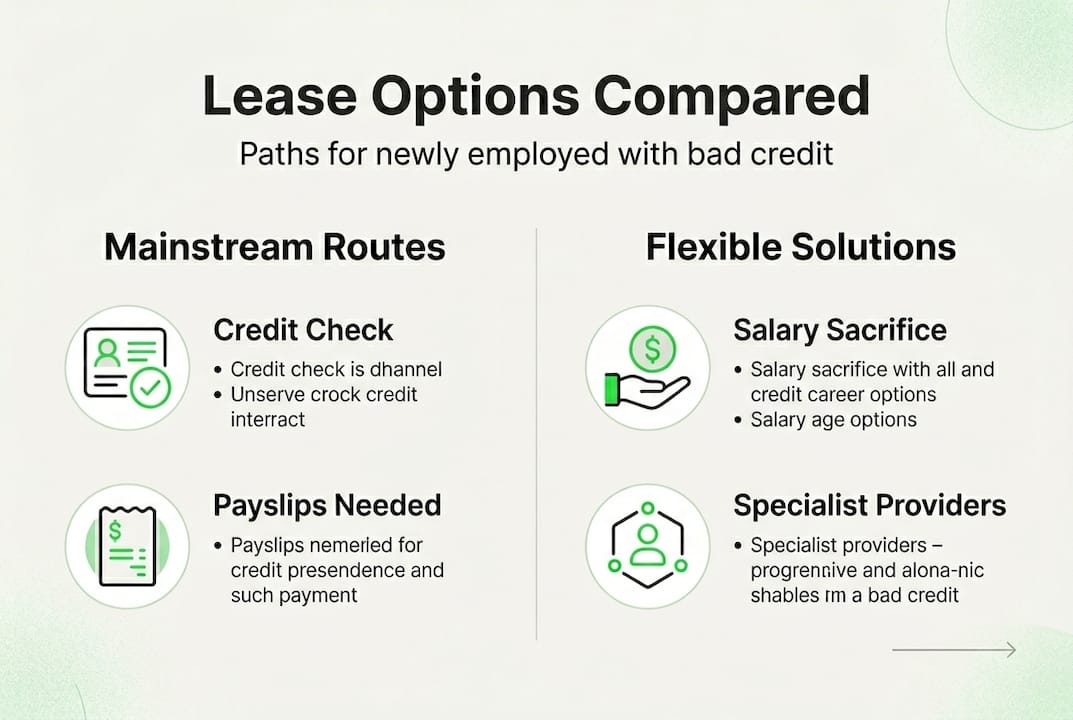
Salary sacrifice schemes provide the best solution for those with employer access, bypassing personal credit checks entirely whilst delivering tax savings. The catch is that you must typically complete your probation period, and not all employers participate. For newly employed individuals in companies offering these schemes, this route combines affordability with accessibility, making it the ideal choice when available.
Specialist bad credit providers fill the gap for those unable to access mainstream or salary sacrifice options. No empirical success rates found; specialist providers claim high approval for bad credit via case-by-case assessment since 1999, but higher costs are expected. These providers examine your full financial picture rather than relying solely on credit scores, considering income stability, deposit size, and overall affordability. Approval rates are higher, but you will pay a premium through elevated interest rates or larger deposits.
| Leasing option | Credit check required | Typical approval rate | Monthly cost | Best for |
|---|---|---|---|---|
| Mainstream leasing | Yes, hard check | Moderate for bad credit | £250-£400 | Good credit, 3+ months employed |
| Salary sacrifice | No personal check | High if eligible | £200-£350 | Post-probation employees |
| Specialist providers | Yes, but flexible | High | £300-£500 | Bad credit, immediate need |
| Short-term flexible | Soft check often | Very high | £350-£600 | New employment, building credit |
Pro Tip: Start with salary sacrifice if your employer offers it, then explore specialist providers if you need a vehicle before completing probation. Avoid mainstream applications until you have at least three months of employment history and a credit score above 600.
Costs vary significantly based on your credit profile and chosen route. Mainstream leasing might charge 5% to 8% APR for good credit, whilst specialist providers can charge 15% to 25% for bad credit cases. Salary sacrifice schemes often work out cheaper overall due to tax savings, even if the headline monthly payment appears similar. When comparing options, calculate the total cost over the lease term including deposits, monthly payments, and any fees, rather than focusing solely on the monthly figure.
The approval timeline also differs. Mainstream leasing can take one to two weeks for full approval and vehicle delivery. Salary sacrifice schemes move faster once you are eligible, often completing within days since credit checks are minimal. Specialist providers typically approve within 24 to 48 hours due to their flexible criteria, making them suitable for urgent needs. Understanding these trade-offs helps you select the option that balances your timeline, budget, and approval likelihood. For comprehensive guidance on leasing options for limited credit, consider providers who specialise in flexible terms for newly employed individuals.
Explore flexible leasing solutions tailored for you
Navigating car leasing as a newly employed individual with bad or limited credit does not have to be complicated. Flexible leasing plans designed specifically for varied credit profiles offer realistic pathways to vehicle ownership without the traditional barriers. Whether you need minimal documentation, shorter contract terms, or simply want expert guidance through the approval process, solutions exist that prioritise accessibility alongside affordability.

With a range of vehicles and contract lengths tailored to personal needs, you can find options that fit your budget and employment situation. Expert advisors understand the unique challenges newly employed individuals face and can guide you through the leasing process step by step. From soft credit checks that protect your score to flexible approval criteria that consider your full financial picture, the right support makes securing a vehicle straightforward. Explore flexible auto lease options designed to get you driving quickly, regardless of your credit history or how recently you started your new job.
Frequently asked questions
Can I lease a car if I have just started a new job?
Yes, you can lease a car as a newly employed individual, though mainstream leasing requires proof of income via payslips and stable employment. Most providers want to see at least three months of payslips to verify consistent income, though some flexible lenders accept less. Salary sacrifice schemes often require you to complete your probation period before qualifying, as employers need assurance of job stability. If you need a vehicle immediately, specialist providers may approve your application with just one or two payslips, though you will likely pay higher rates.
How does a salary sacrifice car leasing scheme work?
Salary sacrifice allows employers to lease the vehicle, deducting payments pre-tax from salary, bypassing personal credit checks. Your employer enters into the lease agreement and you pay for the car through salary deductions before income tax is calculated. This reduces your taxable income, delivering savings of 20% to 50% compared to personal leasing. The scheme typically includes insurance, maintenance, and road tax in one monthly payment. Because the employer holds the lease, your personal credit history is not assessed, making this ideal for newly employed individuals with bad or limited credit.
What can I do to improve my chances of leasing with bad credit?
Checking credit reports, using soft checks, larger deposits, and proving affordability improve leasing chances. Start by obtaining your credit report from Experian, Equifax, and TransUnion, then dispute any errors that could be lowering your score. Use comparison tools that perform soft eligibility checks to explore options without damaging your credit further. Save for a deposit of 15% or more to reduce lender risk, and choose a more affordable vehicle that keeps monthly payments manageable. Provide comprehensive proof of income and affordability, including payslips, bank statements, and a breakdown of your monthly expenses.
Are specialist bad credit leasing providers more expensive?
Yes, specialist providers typically charge higher rates because they accept greater risk by approving applicants with bad or limited credit. Interest rates can range from 15% to 25% compared to 5% to 8% for mainstream leasing with good credit. You may also need to provide a larger deposit, often 15% to 20% of the vehicle's value. However, the trade-off is significantly higher approval rates and faster processing, often within 24 to 48 hours. For newly employed individuals who need a vehicle urgently and cannot access salary sacrifice schemes, the premium cost may be worthwhile to secure reliable transportation whilst building credit.