

Securing a vehicle when you've just entered the UK workforce can feel impossible if your credit history is thin or poor. Yet 74% of UK graduates work in professional roles, demonstrating stable employment that should support vehicle access. The challenge lies in traditional finance routes that prioritise credit scores over current income. Leasing offers a flexible alternative, bypassing these barriers through employer-backed schemes or specialist providers focused on your present financial situation rather than past credit missteps. This article explores how leasing works for new employees, compares your options, and provides actionable strategies to secure a vehicle whilst building credit during your career transition.
Table of Contents
- Key takeaways
- Understanding leasing and its role for new employees
- Nuances of leasing options and specialist support for poor credit
- Practical applications: leasing strategies for new employees transitioning into work
- Explore flexible leasing options tailored for new employees
- Frequently asked questions
Key Takeaways
| Point | Details |
|---|---|
| Salary sacrifice leasing | Employer backed salary sacrifice schemes reduce personal credit checks and focus on current income. |
| Short term leasing | Contracts lasting six to twenty four months align with probation and reduce long term commitment risk. |
| Credit building through payments | Regular lease payments reported to credit reference agencies can build a positive credit history over time. |
| Credit reporting essential | Ask providers to confirm that they report payments to credit agencies, as not all do. |
| No upfront deposits | Leasing offers access to newer vehicles without large upfront deposits. |
Understanding leasing and its role for new employees
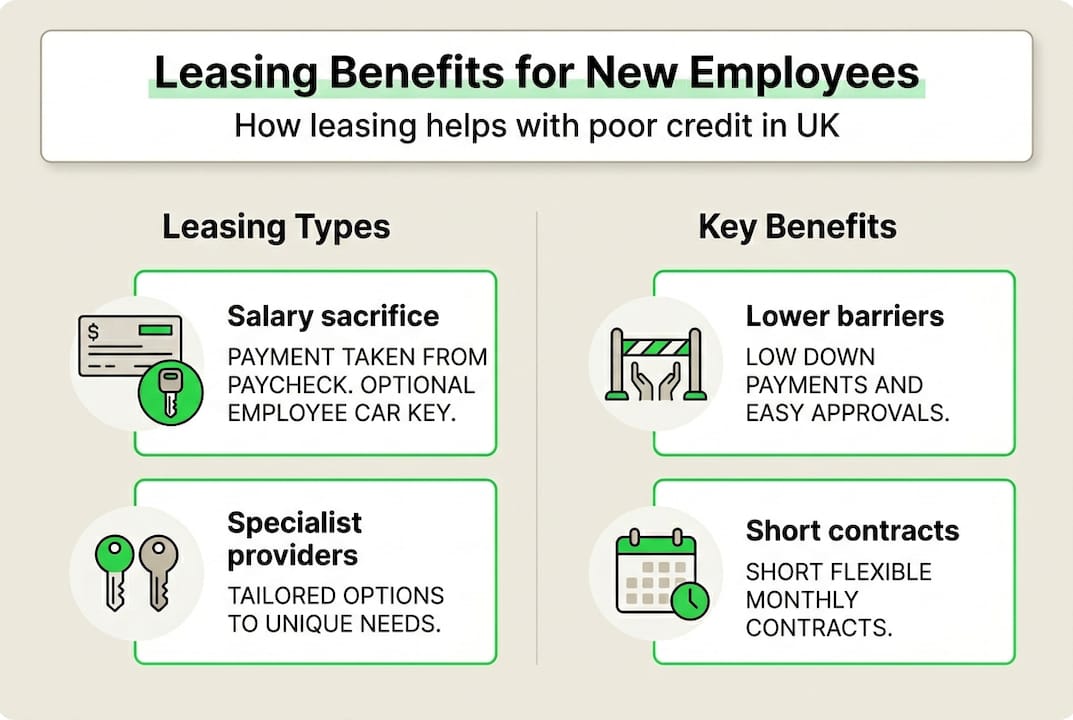
Leasing fundamentally differs from traditional car finance by allowing you to use a vehicle for a fixed period without owning it. For new UK employees with limited or poor credit, this distinction becomes crucial. Traditional hire purchase or personal contract purchase agreements rely heavily on credit scores, often rejecting applicants with thin files or past financial difficulties. Leasing, particularly through salary sacrifice schemes or specialist bad credit providers, shifts the focus from historical credit performance to current income and employment stability.
Salary sacrifice schemes operate by deducting lease payments from your gross salary before tax calculation. Your employer essentially backs the agreement, reducing the provider's risk and often eliminating personal credit checks entirely. This arrangement suits new employees in stable roles because the employer's involvement reassures the leasing company. However, probationary periods complicate this, as we'll explore shortly.
Specialist bad credit leasing providers take a different approach. They assess your current financial situation, prioritising recent payslips, bank statements, and employment contracts over credit history. This method particularly benefits recent graduates or career changers whose credit files don't reflect their current earning capacity. These providers understand that a thin credit file doesn't equate to financial irresponsibility, just limited borrowing history.
Short-term leasing contracts, typically ranging from six to twenty-four months, align perfectly with the uncertainty new employees face during probation. You're not locked into multi-year commitments, allowing flexibility if your employment circumstances change. Additionally, making regular lease payments that are reported to credit reference agencies helps build your credit score over time, creating a positive feedback loop for future financial applications.
Pro Tip: Request confirmation from your leasing provider that they report payments to credit agencies. Not all do, and this reporting is essential for credit building.
Key benefits of leasing for new employees include:
- Access to newer, more reliable vehicles without large upfront deposits
- Predictable monthly costs covering insurance, maintenance, and road tax
- Flexibility to upgrade or change vehicles as your career and needs evolve
- Opportunity to build credit history through consistent payment records
- No depreciation risk since you don't own the vehicle
For those exploring leasing with new employment, understanding these mechanisms clarifies why leasing often succeeds where traditional finance fails. The next section examines specific leasing types in detail, helping you identify which approach suits your employment status and credit profile.
Nuances of leasing options and specialist support for poor credit
Not all leasing routes work equally well for new employees. The two primary options, salary sacrifice and specialist bad credit leasing, each carry distinct advantages and limitations that directly impact your approval chances and financial risk.

Salary sacrifice schemes shine for employees in permanent roles with stable employers. Because payments come from pre-tax salary, you benefit from reduced National Insurance contributions and potentially lower income tax, making the effective cost cheaper than equivalent post-tax finance. Employers offering these schemes typically partner with established leasing companies, providing access to competitive rates and comprehensive vehicle maintenance packages. However, salary sacrifice works best with stable employment but poses risks for probationary new hires, since leaving employment during the lease term can trigger significant early termination charges or require you to continue payments without the tax benefits.
Specialist bad credit leasing providers fill the gap for those on probation or with poor credit histories. These companies explicitly cater to applicants traditional lenders reject, using affordability assessments based on current income rather than credit scores. You'll typically face higher interest rates compared to prime borrowers, reflecting the increased risk the provider accepts. However, approval rates are substantially higher, and many specialists offer flexible terms allowing early termination with reduced penalties, acknowledging the employment uncertainty new workers face.
Pro Tip: Compare total lease costs, not just monthly payments. Specialists may advertise low monthly rates but extend terms or add fees that increase overall expense.
| Leasing method | Best for | Pros | Cons |
|---|---|---|---|
| Salary sacrifice | Permanent employees past probation | Tax savings, employer backing, comprehensive packages | High early termination costs, requires stable employment |
| Specialist bad credit leasing | Probationary or poor credit new employees | High approval rates, flexible terms, income-focused assessment | Higher interest rates, potential upfront fees |
| Short-term personal lease | Those needing maximum flexibility | No long commitment, easier to exit, builds credit | Higher monthly cost per month, limited vehicle choice |
When comparing leasing vs hire purchase options, remember that hire purchase requires stronger credit and builds equity through ownership, whilst leasing prioritises flexibility and lower barriers to entry. For new employees, leasing's accessibility usually outweighs hire purchase's ownership benefits, especially during the first year of employment when job security remains uncertain.
Electric vehicle leasing deserves special mention. Government incentives and employer National Insurance savings make EV salary sacrifice schemes particularly attractive, often resulting in monthly costs lower than equivalent petrol vehicles. Specialists also increasingly offer EVs, recognising growing demand and lower running costs that improve affordability assessments.
Selecting between these options depends on honest assessment of your employment stability and credit situation. If you've completed probation and your employer offers salary sacrifice, the tax advantages make it compelling. If you're still proving yourself in a new role or carry poor credit, specialist providers offer the access you need with manageable risk. The next section translates this understanding into practical steps you can take today.
Practical applications: leasing strategies for new employees transitioning into work
Knowing your options means little without a clear strategy for securing and maximising leasing benefits. Follow these steps to navigate leasing as a new employee:
-
Assess your employment stability. Review your contract terms, noting probation length and any performance milestones. If you're within your first three months, specialist bad credit leasing offers safer flexibility than salary sacrifice.
-
Gather financial documentation. Collect recent payslips, bank statements showing regular income, your employment contract, and proof of address. Specialist providers rely on these documents more than credit reports.
-
Calculate affordable monthly payments. Use the 15% rule: your total vehicle costs shouldn't exceed 15% of your net monthly income. Include insurance, fuel, and any lease fees in this calculation.
-
Research provider reputations. Check reviews specifically mentioning approval processes and customer service for bad credit applicants. Avoid providers with numerous complaints about hidden fees or aggressive collection practices.
-
Apply strategically. Submit applications to specialist providers first, as they perform soft credit checks that don't impact your score. Only pursue salary sacrifice after confirming eligibility with your employer.
Managing probation period risks requires additional caution. Short-term leases of six to twelve months align with typical probation lengths, allowing you to reassess once your employment confirms. Some specialists offer break clauses at six months with minimal penalties, providing an escape route if employment doesn't work out. Always read termination terms carefully before signing.
Using leasing to build credit involves consistent, on-time payments. Set up direct debits to avoid missed payments, which damage your score significantly. After six months of regular payments, check your credit report to verify the lease appears and payments are recorded correctly. This positive history gradually improves your score, opening access to better financial products.
Electric vehicle leasing offers particular advantages for new employees. Leasing costs for EVs fell again in 2025, continuing a multi-year trend driven by increased supply and government incentives. EVs eliminate fuel costs, replacing them with cheaper electricity, and salary sacrifice schemes for EVs carry additional tax benefits. If your commute is predictable and charging is available at home or work, an EV lease can cost less monthly than a petrol equivalent whilst supporting environmental goals.
Practical checklist for short-term leasing as a new employee with poor credit:
- Employment contract showing at least three months' tenure
- Three recent consecutive payslips demonstrating stable income
- Bank statements proving affordability without overdraft reliance
- Proof of UK address and driving licence validity
- Clear understanding of total lease costs including all fees
- Confirmation that payments will be reported to credit agencies
- Emergency fund covering at least two months' lease payments
These strategies transform leasing from an abstract option into an actionable plan. By matching leasing type to your specific employment and credit circumstances, you maximise approval chances whilst minimising financial risk during your career transition. The following section connects these insights to specific services designed for your situation.
Explore flexible leasing options tailored for new employees
Navigating leasing options as a new employee with limited credit doesn't have to feel overwhelming. Flexi Auto Lease specialises in flexible vehicle leasing solutions designed specifically for individuals facing credit challenges or employment transitions. Whether you're on probation, rebuilding credit, or simply lack borrowing history, their approach focuses on your current financial situation rather than past credit missteps.

Their flexible terms range from six to twenty-four months, aligning perfectly with probationary periods and allowing you to adjust as your employment stabilises. All-inclusive pricing covers road tax, maintenance, and breakdown assistance, eliminating surprise costs that strain tight budgets. Soft credit checks mean exploring your options won't damage your score, and nationwide delivery brings your vehicle directly to you within days of approval. Expert advisers provide personalised guidance, helping match lease terms and vehicle types to your specific circumstances. If you're exploring leasing with new employment, their team understands the unique challenges you face and structures agreements accordingly. Visit their site for a no-obligation consultation and discover how accessible vehicle leasing can be, regardless of your credit history.
Frequently asked questions
What are the main benefits of leasing for new employees with poor credit?
Leasing bypasses traditional credit barriers by focusing on current income and employment rather than credit history. You gain access to reliable vehicles with predictable monthly costs covering maintenance and tax, whilst building positive credit through regular payments. Short-term flexibility suits probationary periods, reducing risk if employment circumstances change.
Will leasing a car affect my credit score negatively?
Initial soft credit checks don't impact your score. Once approved, regular on-time lease payments reported to credit agencies actually improve your score over time. Only missed or late payments damage credit, so setting up direct debits ensures positive reporting that strengthens your credit file.
Can I lease a vehicle whilst still on probation at my new job?
Yes, specialist bad credit leasing providers specifically accommodate probationary employees by assessing current income and employment contracts rather than job tenure. Choose shorter lease terms of six to twelve months to match your probation period, and confirm any early termination clauses in case your employment doesn't continue.
How much should I budget for vehicle leasing as a new employee?
Aim to keep total vehicle costs, including lease payments, insurance, and fuel, below 15% of your net monthly income. For example, if you earn £2,000 monthly after tax, budget no more than £300 total for vehicle expenses. This ensures affordability without straining other essential costs during your career transition.
Do I need a large deposit to lease with poor credit?
Many specialist providers offer low or zero deposit leasing specifically for bad credit applicants, though some may require one to three months' payments upfront. This initial payment reduces the provider's risk and can lower your monthly costs. Compare total lease expenses across providers, as some offset low deposits with higher monthly rates.