

Managing a fleet feels like a luxury reserved for large corporations with deep pockets and spotless credit files. Many small business owners and self-employed professionals assume that running even two or three vehicles requires a significant upfront investment or a perfect financial history. That assumption is costing businesses real money and real opportunity. Flexible leasing has quietly become one of the most practical tools available to UK SMEs (small and medium-sized enterprises), and it works whether you have excellent credit or a complicated financial past.
Table of Contents
- Understanding fleet management challenges for UK small businesses
- How leasing simplifies fleet management and supports business growth
- Flexible leasing vs traditional vehicle finance: what's the difference?
- Adapting your fleet quickly with short-term leasing
- Choosing the right leasing option for your business needs
- Common questions and terminology in UK fleet leasing
- Explore flexible leasing solutions for your fleet
- Frequently asked questions
Key Takeaways
| Point | Details |
|---|---|
| Flexible contracts | Leasing lets you adapt your fleet size and type quickly for changing business needs. |
| Credit-friendly options | Many leasing solutions do not require hard credit checks, protecting your credit score. |
| Cash flow advantage | Leasing avoids large upfront costs and supports smoother cash flow management for SMEs. |
| Transparent terms | Understanding contract details and terminology ensures you get the best deal for your business. |
Understanding fleet management challenges for UK small businesses
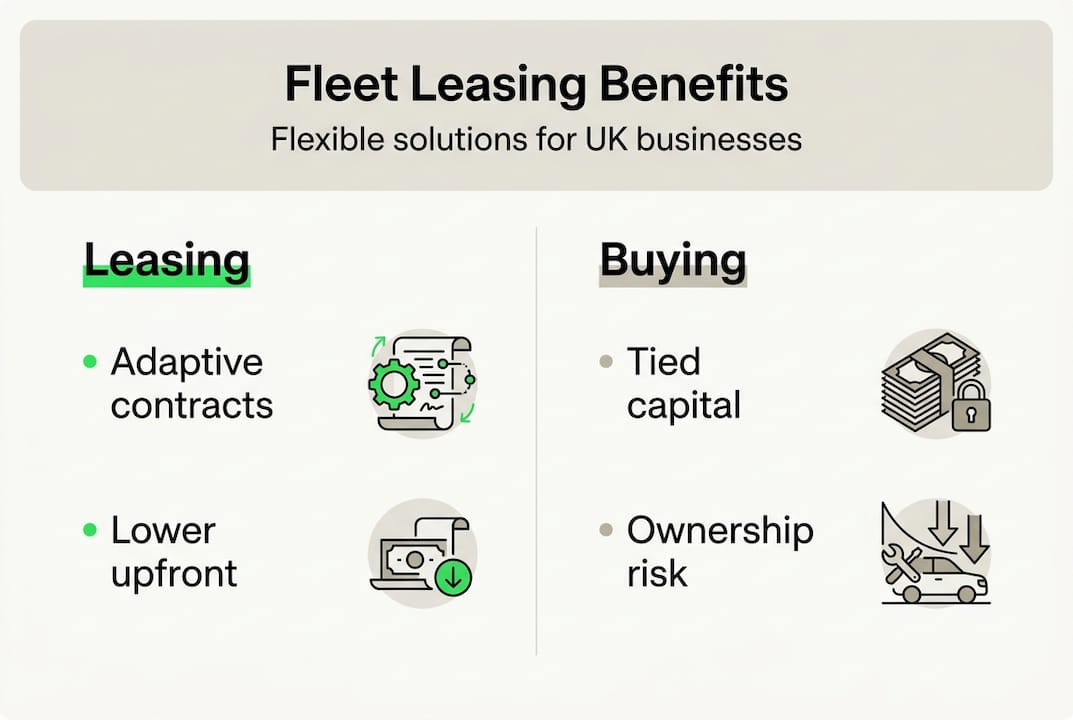
Buying vehicles outright ties up capital that most small businesses simply cannot afford to lock away. A single commercial van can cost £25,000 or more, and that money could otherwise fund stock, staff, or marketing. Fleet cash flow challenges are one of the most common reasons SMEs struggle to scale their operations.
Beyond the upfront cost, business needs change constantly. You might win a large contract in March that requires three extra vehicles, then find yourself with surplus capacity by September. Owning vehicles makes that kind of flexibility nearly impossible without significant financial loss.
Credit concerns add another layer of difficulty. Many sole traders and newer businesses have limited credit histories, which makes traditional vehicle finance hard to access. Leasing for limited credit has grown as a genuine alternative precisely because it removes that barrier for many applicants.
Here is a quick summary of the core challenges small businesses face with traditional fleet management:
- High upfront purchase costs that drain working capital
- Inflexible ownership that makes scaling up or down expensive
- Credit score requirements that exclude many SMEs from standard finance
- Depreciation risk as owned vehicles lose value over time
- Maintenance and tax admin that adds hidden costs to ownership
"Traditional vehicle procurement can strain finances and limit options for SMEs."
Leasing directly addresses each of these pain points, which is why it has become the go-to option for businesses that need vehicles without the financial baggage of ownership.
How leasing simplifies fleet management and supports business growth
The core appeal of leasing is straightforward: you pay a fixed monthly amount to use a vehicle, without ever owning it. There is no large deposit eating into your cash reserves, and no depreciation risk sitting on your balance sheet. You simply drive, and at the end of the contract, you hand the keys back.

Short-term leasing benefits go further than just cost savings. Many providers now offer contracts that avoid hard credit checks entirely, meaning your credit score stays intact throughout the process. Flexible leasing options now avoid traditional credit checks for many small businesses, opening the door for sole traders and newer enterprises that would otherwise be turned away.
Contract length flexibility is another major advantage. Rather than being locked into a five-year finance agreement, you can choose a contract that matches your actual business cycle, whether that is six months, twelve months, or longer.
Key benefits that make leasing work for small businesses:
- Predictable monthly costs that make budgeting far simpler
- No depreciation exposure since you never own the asset
- All-inclusive packages covering road tax, maintenance, and breakdown cover
- Quick approval allowing you to be on the road within days
- Soft or no credit checks protecting your financial profile
Pro Tip: If your business income fluctuates seasonally, look for leasing contracts with flexible mileage options. Overestimating your mileage upfront is cheaper than paying excess mileage charges at the end.
Did you know? The UK vehicle leasing market has grown significantly in recent years, with flexible and short-term contracts now accounting for a rising share of all business vehicle arrangements. More SMEs are choosing leasing over ownership because the numbers simply make more sense.
Flexible leasing vs traditional vehicle finance: what's the difference?
Understanding your options is essential before committing to any vehicle arrangement. Leasing vs hire purchase is a comparison worth making carefully, because the differences in flexibility, credit impact, and monthly cost are significant.
Hire purchase (HP) means you pay in instalments and own the vehicle at the end. That sounds appealing, but it requires a hard credit check, a deposit, and a long-term commitment. Personal Contract Purchase (PCP) works similarly, with a large optional payment at the end if you want to keep the vehicle.
Leasing offers more flexibility in contract terms than hire purchase or outright buying, which matters enormously when your business needs can shift within a single quarter.
| Feature | Flexible leasing | Hire purchase | Outright purchase |
|---|---|---|---|
| Upfront cost | Low or none | Deposit required | Full purchase price |
| Credit check | Soft or none | Hard check | None |
| Contract flexibility | High | Low | N/A |
| Monthly cost | Fixed and predictable | Fixed | None (but capital tied up) |
| Asset ownership | No | Yes (at end) | Yes |
| Maintenance included | Often yes | No | No |
| Depreciation risk | None | Yes | Yes |
Here is a numbered breakdown of why leasing wins for most SMEs:
- Lower barrier to entry with minimal upfront cost
- No long-term commitment that outlasts your business needs
- Credit score protection through soft or no checks
- Simpler admin with all-inclusive packages handling tax and maintenance
- Easy exit at contract end with no resale headaches
Adapting your fleet quickly with short-term leasing
One of the most underrated advantages of leasing is speed. When you win a new contract and need an extra vehicle within the week, ownership simply cannot move that fast. Short-term leasing can. Short-term contracts are becoming a standard for modern UK fleet managers precisely because business conditions demand that kind of agility.
Consider these common scenarios where short-term leasing makes immediate sense:
- A sole trader decorator needs a van for a six-month commercial project
- A small courier firm requires two extra vehicles during the Christmas peak
- A new consultancy wants a professional car without committing to ownership
- A seasonal landscaping business needs fleet capacity from April to October only
Here is a practical reference table for typical UK business scenarios:
| Business scenario | Recommended contract length | Typical monthly cost range |
|---|---|---|
| Short project or contract | 6 months | £250 to £450 |
| Seasonal demand spike | 6 to 12 months | £280 to £500 |
| New business launch | 12 months | £300 to £550 |
| Steady ongoing operations | 12 to 24 months | £320 to £600 |
| Fleet expansion trial | 6 to 12 months | £270 to £480 |
Note: Costs vary by vehicle type, mileage, and provider. Commercial vans typically sit at the higher end of these ranges.
Before signing any contract, use a car lease checklist to confirm the terms suit your specific situation. Checking mileage allowances, early exit clauses, and maintenance inclusions upfront saves significant hassle later.
Pro Tip: Always ask about early termination options before signing. Some providers allow you to exit after a minimum period with a modest fee, which is far better than being locked in if your business circumstances change.
For more detailed guidance, the car leasing tips resource covers the most common mistakes small businesses make when arranging fleet vehicles.
Choosing the right leasing option for your business needs
Not every leasing deal is the same, and the right choice depends on your specific business profile. Different SMEs require tailored contract lengths and vehicles to match their operations, so a one-size-fits-all approach rarely works.
Follow these steps to find the best leasing arrangement for your business:
- Assess your mileage honestly. Underestimating leads to excess mileage charges. Track your current driving patterns for at least a month before committing.
- Choose the right vehicle type. A sole trader visiting clients needs something different from a tradesperson carrying tools and materials.
- Match contract length to your business cycle. If your work is project-based, choose shorter contracts. If you have stable, ongoing operations, a 24-month deal often offers better value.
- Check what is included. All-inclusive packages covering road tax, servicing, and tyres simplify your admin and protect your budget.
- Confirm the credit check process. Ask upfront whether the provider uses a soft check or no check, so you know your credit profile is protected.
Key factors to prioritise when comparing providers:
- Nationwide delivery so geography does not limit your choices
- Vehicle range covering cars, SUVs, electric vehicles, and vans
- Transparent pricing with no hidden fees buried in the small print
- Responsive customer service that can adapt your arrangement if circumstances change
If your business is newly established or you are self-employed, explore leasing with new employment options specifically designed for applicants without a long financial track record.
Common questions and terminology in UK fleet leasing
Leasing contracts come with their own vocabulary, and van leasing terminology can feel overwhelming at first. Most UK businesses find leasing terminology confusing, but a few key definitions make the process far clearer.
Here are the terms you will encounter most often:
- Initial rental: The upfront payment at the start of a lease, usually equivalent to one to three months' payments
- Excess mileage charge: A per-mile fee applied if you exceed your agreed annual mileage
- Fair wear and tear: The acceptable level of minor use-related marks on a returned vehicle
- Residual value: The estimated worth of the vehicle at the end of the contract (affects your monthly cost)
- Soft credit check: A background check that does not appear on your credit file or affect your score
- Early termination fee: The charge for ending a contract before the agreed end date
"Understanding these terms before you sign means you will never be caught out by unexpected charges at the end of your contract."
Always read the fair wear and tear guidelines provided by your leasing company before returning a vehicle. Minor scuffs within those guidelines cost you nothing. Damage outside them can result in charges, so knowing the difference matters.
Explore flexible leasing solutions for your fleet
Flexible leasing removes the biggest obstacles that hold small businesses back from having the vehicles they need: high upfront costs, rigid contracts, and credit score concerns. Whether you need one van for a six-month project or a small fleet for ongoing operations, the right leasing arrangement can be in place faster than you might expect.

At Flexi Auto Lease, we work specifically with small businesses, sole traders, and self-employed professionals across the UK. Our process involves no hard credit checks, all-inclusive pricing, and nationwide delivery so you can focus on running your business rather than worrying about vehicle admin. Browse our full range of cars, vans, SUVs, and electric vehicles at flexible leasing solutions and see how quickly we can get you on the road.
Frequently asked questions
Will short-term leasing affect my credit score?
Most flexible leasing arrangements in the UK do not perform hard credit checks, so your credit score remains unaffected. Providers like Flexi Auto Lease use soft or no checks, meaning your financial profile stays intact throughout the application process.
Can I change my fleet size quickly with leasing?
Short-term and flexible leasing allow you to scale your fleet up or down based on your current business needs. Short-term contracts are now standard for UK fleet managers who need that level of agility.
What happens at the end of a leasing contract?
You simply return the vehicle at the contract's end, often with options to renew or choose a different model. Tailored contract lengths mean you are never stuck with a vehicle that no longer suits your business.
Which leasing terms should I focus on?
Prioritise contract length, mileage limits, and early exit options to ensure maximum flexibility. Understanding key leasing terminology before you sign prevents unexpected charges later.
Is leasing suitable for new businesses or the self-employed?
Absolutely. Leasing options are designed to suit businesses of all sizes, including new and self-employed enterprises. Flexible contract terms mean you do not need a long financial track record to access a quality vehicle.